
Mark S. Manger
Investing in Protection
The idea for the book was born from a conversation with Noboru Hatakeyama, a former top official in Japan’s Ministry of International Trade and Industry—the (in)famous MITI—in the fall of 2002. I had just arrived in Japan with a completely different research project in mind, but found that the foreign policy establishment was wholly occupied with the free trade agreements that Japan had just started to negotiate. Hatakeyama was one of the key figures in promoting the new policy. Since the end of the US occupation, Japan had relied on multilateral trade institutions, avoided any preferential agreements, and only reluctantly negotiated bilaterally with the US, which were worried about the strength of Japanese exports in the 1980s.
Now Japan turned its policy completely around, engaging in a flurry of bilateral negotiations. The driving force behind this change was a realization that Japanese firms were strongly discriminated against in their activities abroad. Seen from Japan, NAFTA appeared almost purposefully designed to make it hard for the likes of Nissan and Panasonic to operate in Mexico.
It was an exciting time to be in Tokyo, and I spent the next six months running from meetings with trade officials to workshops with academics to interviews with company and trade association representatives.
Some of the work was more like investigative journalism than social science research. In Japan, the private sector prefers to let the government take the lead; getting the unofficial version of a policy is often hard.
Because of this reluctance to discuss views publicly, especially with foreigners, and because the English-speaking, urbane, elite bureaucrats are much more accessible, many at the time thought that Japan’s trade agreements were a government-driven project.
But once I scratched the surface of this new strategic policy consensus, I came upon a fierce battle between different interest groups whose strategic priority was their own material gain. In short, despite a different institutional and cultural context, it was a way of policymaking that any observer of US politics would immediately recognize.
This allowed me to extend the study into large, comparative framework. It turns out that North-South PTAs follow a similar pattern, whether the powerful party is Japan, the US, or the EU.
The developing country usually swallows whatever is offered in return for the promise of more foreign investment, or the veiled threat that others are standing in line ready to sign their own deal. In the book, I analyze the cases of NAFTA, the EU-Mexico and Japan-Mexico FTAs, the agreements that the US and the EU have negotiated with Chile, and the “Economic Partnership Agreements” that Japan has sought with Thailand and Malaysia.
Approaching the analysis through such qualitative case work has its risks. It seems almost a universal rule of human behavior that whenever we pursue our naked self-interest, we justify it with reference to the greater social good.
Politicians and lobbyists have mastered this to the point where they believe their own words—turning them into what Marx called “character masks.” For the researcher, this means that we can never take statements at face value and must avoid asking for motivations, and instead trace decisions and identify critical junctures. In short, we must objectify our subjects, and ask if our theories predict their actions rather than their words. But doing so also gives us a much deeper insight into the policy-making process than looking for statistical correlations.
Editor: Erind Pajo
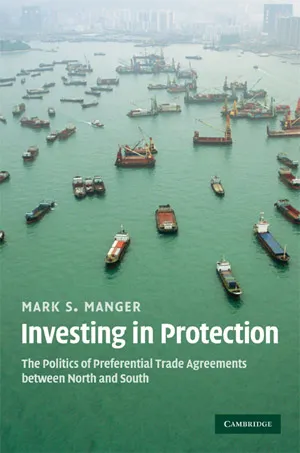
Investing in Protection
Mark S. Manger Investing in Protection: The Politics of Preferential Trade Agreements between North and South Cambridge University Press 284 pages, 9 x 6 inches ISBN 978 0521748704
Available here →February 15, 2010
20100215-mark-manger-on-investing-protection-preferential-trade-agreements-2
The wide angle
The rest of this thread

Mark S. Manger
Mark S. Manger is a Lecturer in the Department of International Relations at the London School of Economics, where he teaches in the International Political Economy program. He previously taught at McGill and was a fellow in the Harvard US-Japan program. His research focuses on North-South relations, with a particular interest in the Asia Pacific region. His work has been published in World Development and the Review of International Political Economy. Despite his schooling in a positivist political science and economics tradition, he still catches himself thinking Marxist thoughts from time to time.
Pull this thread
pulls againstpulls alongside
North-South trade agreements are really about foreign investment, driven by multinationals, and each one breeds the next.
Against RE · The 1743 Memoirs of an Unfortunate Young Nobleman, reprinted as a novel, is substantially true. On: The reasons participants give for what they do are reliable evidence about why they do it
Against EC · Ordinary early Americans, not legislators, made the legal culture, because even the illiterate and enslaved knew the common law. On: The reasons participants give for what they do are reliable evidence about why they do it
Alongside TW · Jazz history, told as a succession of God-like male heroes, enforces masculine and heterosexual norms. On: The reasons participants give for what they do are reliable evidence about why they do it
Alongside WG · Ordinary Soviet citizens made the Great Terror, writing denunciations and naming names out of belief and fear at once. On: The reasons participants give for what they do are reliable evidence about why they do it
Alongside ML · Veiling is not a private decision, and women should not wear the hijab. On: The reasons participants give for what they do are reliable evidence about why they do it
Alongside SK · Anti-Asian violence in America is a continuous 175-year pattern, and denying its racial motive is part of the pattern. On: The reasons participants give for what they do are reliable evidence about why they do it
Know something the rest of us don't?
Most threads on Rorotoko begin with our invitation. Any thread can begin with a proposal: you write it with the same prompts every thread answers, and we review it.
Propose a thread →