
Jan Kenneth Birksted
Le Corbusier and the Occult
There are 170 illustrations in Le Corbusier and the Occult. And they are not just pretty pictures. Some of them tell stories in their right.
One reviewer said that he could not understand the relevance of such a picture as the late nineteenth-century photograph of a Chaux-de-Fonnier boy in a Biedermeier apartment, looking wistfully past the net-curtains at the world outside. And, yes, the boy in the photograph is not Jeanneret. But the photo is emblematic of what it would have been like for an ambitious child to grow up in exactly that kind of stifling petty bourgeois milieu in La Chaux-de-Fonds with its drapes, crystal gold-fish bowls, aspidistras and all the associated mental baggage: a domestic etui as described by Walter Benjamin.
Then there are photographs in the book that provide evidence and replace written text: these photographs reveal history. Such are the images of Masonic rituals.
Le Corbusier and the Occult is an intensely visual book. You can flip through it as if through a storyboard and you will get the narrative. I am deeply grateful to the MIT Press—and in particular to Roger Conover, my commissioning editor. It is a joint achievement, in fact, that Le Corbusier and the Occult became a “concept” book worth collecting—even if you were not to read all the words.
I write in the introduction that it is now up to others to follow up the hypotheses, research methods, and historiographical approaches I outline, in order to prove, improve or disprove my research findings.
Hayden White (in his classic book, Metahistory) expresses the desire for a historiography that embodies contemporary ethical ideas. This book embodies my ethical ideas about the importance of historical research methodologies for cross-cultural understanding.
But I also hope that my Burckhardt-like notion of historiographical context will have an effect on architectural history and on our way of thinking about modernism in terms of its underlying regional cultures. There exist other cultures and other ways of being that must be considered and respected if we want to understand architecture.
In 1976, Isaiah Berlin said of Herder, another Freemason: “He deeply hates the forces that make for uniformity, for the assimilation, whether in life or in the books of historians, of one culture or way of life to another. He conscientiously looks for uniformities, but what fascinates him is the exception.”
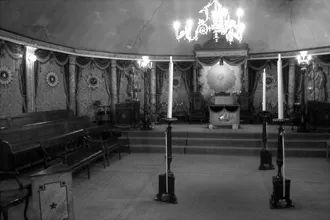
Interior of the Masonic lodge of La Chaux-de-Fonds, La Loge L’Amitié
Editor: Erind Pajo
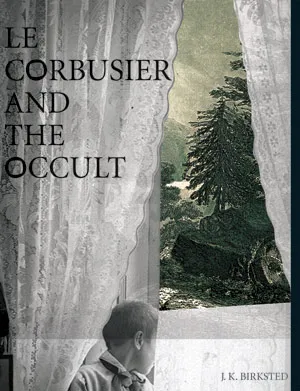
Le Corbusier and the Occult
J. K. Birksted Le Corbusier and the Occult MIT Press 416 pages, 9 x 11 ½ inches ISBN 978 0262026482
Available here →February 19, 2010
20100219-birksted-jan-on-le-corbusier-occult-3
A close-up
The rest of this thread
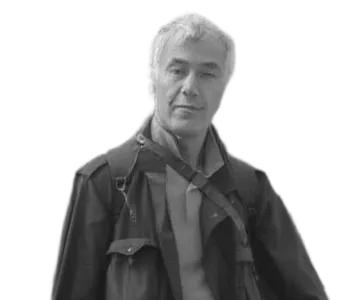
Jan Kenneth Birksted
Jan Kenneth Birksted from the Bartlett School of Architecture at University College London is the editor of two books about landscape architecture and of a monograph, Modernism and the Mediterranean: the Maeght Foundation, about a museum in St.-Paul de Vence that was designed by Josep Lluis Sert. He has received awards from the British Academy, the Graham Foundation for Advanced Studies in the Fine Arts, and the Society of Architectural Historians of Great Britain. He is currently finishing a book about another late building by Sert, a Carmelite convent, Le Carmel de la Paix (1967-1971)””and halfway through another book on Le Corbusier, Le Corbusier and the Body
Pull this thread
Jeanneret borrowed and plagiarized Freemasonry's symbols to win commissions from a ruling class that sat in the lodges.
Know something the rest of us don't?
Most threads on Rorotoko begin with our invitation. Any thread can begin with a proposal: you write it with the same prompts every thread answers, and we review it.
Propose a thread →