
Marc Egnal
Clash of Extremes
Here are my suggestions for browsing Clash of Extremes. Begin with the Introduction: it provides a brief overview and roadmap for the rest of the book. Then take a look at Chapter 4, “Rise of the Lake Economy.” It’s right at the heart of the changes that transformed the North. It’s a chapter filled with portraits of the important, colorful individuals who spoke for the districts near the Great Lakes. Among those featured are Joshua Giddings, “Long John” Wentworth (one of the few lawmakers taller than Lincoln), Benjamin Franklin Wade, and Lewis Cass. The chapter also discusses the emergence of a peculiarly Northern strand of “nationalism”—a belief that “what’s good for the North is good for the entire nation.” That self-serving philosophy would guide the Republicans in the decades after 1860.
Clash of Extremes is an economic interpretation that takes antislavery very seriously. The fifth chapter, “The Campaign Against Slavery,” portrays such activists as William Lloyd Garrison, Salmon Chase, Charles Sumner, and Gerrit Smith. These pages explore why such crusaders had only a limited impact on the North and why moral concerns remained subordinate to economic ones.
After that, if you are still browsing, explore topics that you find intriguing. You might examine Andrew Jackson’s role in party formation (Chapter 1); follow the activities of Robert Barnwell Rhett in leading the campaign for secession (Chapter 10); or see how Ulysses Grant handled the battle against Klan violence (Chapter 13). Among the joys of writing Clash of Extremes—an undertaking that took more than a dozen years—were the exchanges I had with other historians. I am grateful to the many individuals who read the manuscript and provided carefully reasoned critiques. I’ve brought some of that dialogue into the text, for example in discussions of the arguments about the relative importance of antislavery and economics in shaping the North, and in an examination of the various reasons—including the defense of slavery, hysteria, and the breakdown of parties—that scholars have put forth to explain secession. That dialogue continues. Hence I’ve established a website that readers are invited to visit: www.clashofextremes.com. It provides links to all the reviews, blogs, podcasts, and videocasts dealing with my book. It also includes my response to several of the critiques set forth since the book’s publication.
Editor: Erind Pajo
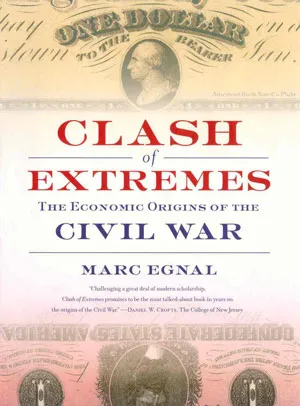
Clash of Extremes
Marc Egnal Clash of Extremes: The Economic Origins of the Civil War Hill and Wang 432 pages, 8 x 5 1/2 inches ISBN 978 0809016457 ISBN 978 0809095360
Available here →February 22, 2010
20100222-egnal-marc-clash-extremes-economic-origins-civil-war-3
A close-up
The rest of this thread
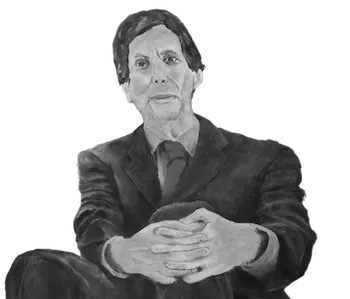
Potrait by Ben Egnal
Marc Egnal
Marc Egnal is a professor of history at York University in Toronto, Canada. He was born in Philadelphia, and educated at Swarthmore College and the University of Wisconsin-Madison. He has written three books in addition to Clash of Extremes: A Mighty Empire: The Origins of the American Revolution (Cornell University Press, 1988); Divergent Paths: How Culture and Institutions Have Shaped North American Growth (Oxford University Press, 1996); and New World Economies: The Growth of the Thirteen Colonies and Early Canada (Oxford University Press, 1998). In 2010 Cornell will reissue A Mighty Empire with a new preface.
Pull this thread
Economics explains why North and South clashed better than slavery does.
Know something the rest of us don't?
Most threads on Rorotoko begin with our invitation. Any thread can begin with a proposal: you write it with the same prompts every thread answers, and we review it.
Propose a thread →