
Jeff Allred
American Modernism and Depression Documentary
Earlier, I began to develop a contrast between Wright’s first person plural in 12 Million Black Voices and Roosevelt’s rhetorical performance of “seeing” the economic violence wrought on the poorest “one third of a nation.” Now, I would like to take a closer look at Wright’s “we” via a different comparison, one I develop in the final chapter: that of Time, Inc. board chairman Henry Luce in his famous essay “The American Century,” also published in 1941.
As I mentioned above, Wright’s text is structured around an antagonistic relationship between a narrating “we” that speaks for the titular “black voices” and a “you” that is initially designated as bourgeois and white. At the beginning of the text, the implied white reader is left blindly picking at the “knot” of blackness whose “snarled strands converge from many points in time and space.” By the end, Wright shifts to a different metaphor, of blackness as a “dark mirror,” to emphasize the extent to which white readers are themselves implicated in African American history and vice versa:Look at us and know us and you will know yourselves, for we are you, looking back at you from the dark mirror of our lives!
What one sees in this dark mirror is not a neatly framed self, but an uncanny mixture of self and other, a nascent “we” whose coalescence is promised but not yet achieved.
The complexity of Wright’s revision of “we, the people” comes into clearer view in contrast to that of Luce, whose “The American Century” was originally entitled “We Americans” and was published in the pages of Life around the time of Wright’s book’s appearance. Luce’s logic is a nearly perfect inversion of Wright’s, assuming the internal coherence and transhistorical persistence of the very “we” whose internal divisions and historical development Wright takes such pains to trace out.
Moreover, Luce’s “we” is explicitly imperial in ways that anticipate the neoconservative ideology of the last several decades. He urges readers to view America, not as a “sanctuary” of democratic ideals but as “the powerhouse from which [these] ideals spread throughout the world and do their mysterious work of lifting the life of mankind from the level of the beasts to what the Psalmist called a little lower than the angels.”
In the final chapter, I examine some ways in which Luce’s flagship publications—Time, Fortune, and especially Life—model this coercive vision of collective identity. I pay special attention to the way Time Inc. publications, no less than the avant-garde work of the period, experimented with new media and new ways of combining images and text. But they did so to nearly opposite political ends, constructing a world in which “we Americans” is a product rather than a process, an answer rather than a question, and outside of history rather than continually produced within it.
Like many critics working at the crossroads of media history, modernism, and photography, I found myself peering over the shoulder of early twentieth century cultural critic Walter Benjamin at many points. In closing, I would like to share one particular moment that helped me to keep in view the central aims of my work.
In his brilliant essay “A Brief History of Photography” (1931) Benjamin analyzes the photographic portraits of his German contemporary August Sander, whose collations of German physical and occupational “types” Benjamin found resonant with the cultural moment. Somewhat enigmatically, Benjamin declares in regard to one of Sander’s published collections, “Sander’s book is more than a book of pictures; it is a book of exercises.”
I began to understand the rich implications of Benjamin’s statement as I worked with Depression-era documentary in the United States, observing that documentary books are not valuable as eyewitnesses to a stable social reality but as little thought experiments in a subjunctive mood: Could this be? What if this were? Might this have been? What if I were you? For Benjamin, Sander’s photographic exercise books presented an alternative to the fascist belief in a “pure” identity that reveals itself fully and immediately to the naked eye. For me, modernist documentary books make similar demands of readers, asking them to see themselves in and through others, implicated in an often traumatic, shared history. It’s my hope that _ American Modernism and Depression Documentary_ can serve as a “book of exercises” in this sense.
Editor: Erind Pajo
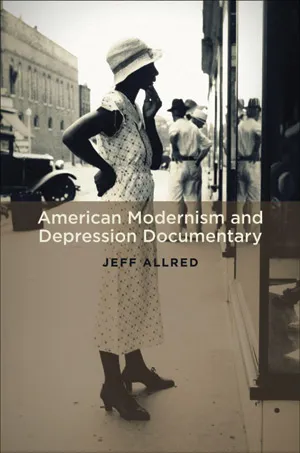
American Modernism and Depression Documentary
Jeff Allred American Modernism and Depression Documentary Oxford University Press 288 pages, 9 x 6½ inches ISBN 978 0195335682
Available here →March 10, 2010
20100310-allred-jeff-on-american-modernism-depression-documentary-3
A close-up
The rest of this thread

Jeff Allred
Jeff Allred is Associate Professor of English at Hunter College of the City University of New York. In addition to American Modernism and Depression Documentary, featured in his Rorotoko book interview, he has published work on American literature, modernism, and media history in American Literature, Criticism: A Quarterly for the Arts, and Arizona Quarterly. Allred has been the recipient of numerous awards and grants, including the Foerster Prize for the best article in American Literature, and a year-long fellowship at the Center for the Humanities at the CUNY Graduate Center. He is currently at work on a book on the relationship between literary modernism and pedagogy in the interwar period, entitled ABCs of Modernism.
Pull this thread
The Depression documentary book deconstructs witness, confronting readers with scattered voices rather than an authoritative picture.
Know something the rest of us don't?
Most threads on Rorotoko begin with our invitation. Any thread can begin with a proposal: you write it with the same prompts every thread answers, and we review it.
Propose a thread →