
Jeff Allred
American Modernism and Depression Documentary
When you hear the words “Great Depression,” certain images pop up: a mother hugging her child on a windswept plain, a hand clutching a tin plate, unemployed men standing in a breadline. We remember the Depression like this in part because of the New Deal cultural projects that turned poor people (especially rural whites) into celebrities of a sort, symbols of the crisis that bourgeois consumers of magazines, exhibitions, newspapers, films, and plays could immediately comprehend, thus seeing, however imperfectly, the outlines of a crisis whose causes were often inscrutable.
My book examines the “documentary books” that were one of the Depression’s most conspicuous cultural forms.
Documentary books combined photographs and text to create an intense, vicarious encounter with social problems. Since the pioneering work of William Stott in the 1970s, many critics have shared his judgment that these books succeed because they “make the reader feel he was firsthand witness to a social condition.” As I engaged these texts, however, I began to feel that the “witness” metaphor, with its assumption of a smooth transmission of meaning from documentarian to readers, was misleading.
These books were much stranger than they initially seemed.
In my readings of several examples of the genre—Erskine Caldwell and Margaret Bourke-White’s You Have Seen Their Faces (1937), James Agee and Walker Evans’s Let Us Now Praise Famous Men (1941), and Richard Wright’s 12 Million Black Voices (1941)—the documentary book is not so much an act of witness as a deconstruction of witness. These texts confront their readers not with a unitary and authoritative representation of problems with clear solutions, but with a multitude of perspectives and voices scattered widely and bewilderingly.
As such, the Great Depression’s documentary books are part of the modernist aesthetic that coalesced in the interwar period. In recounting the various traumas at work on the body politic, often in places geographically remote from cultural centers, artists confronted their audience with techniques borrowed from modernist literature and art—discontinuity between word and image, unannounced shifts in narrative perspective, and shockingly grotesque representations of otherwise familiar people, places, and things—in order to jolt readers into fresh ways of perceiving social problems and new frameworks for imagining their betterment.
Editor: Erind Pajo
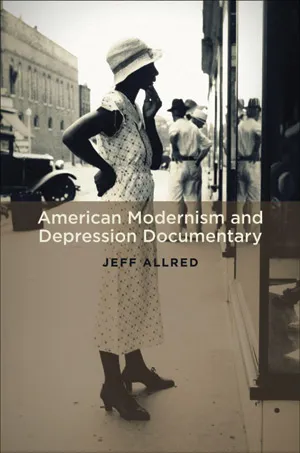
American Modernism and Depression Documentary
Jeff Allred American Modernism and Depression Documentary Oxford University Press 288 pages, 9 x 6½ inches ISBN 978 0195335682
Available here →March 10, 2010
20100310-allred-jeff-on-american-modernism-depression-documentary-1-1
In a nutshell
The rest of this thread

Jeff Allred
Jeff Allred is Associate Professor of English at Hunter College of the City University of New York. In addition to American Modernism and Depression Documentary, featured in his Rorotoko book interview, he has published work on American literature, modernism, and media history in American Literature, Criticism: A Quarterly for the Arts, and Arizona Quarterly. Allred has been the recipient of numerous awards and grants, including the Foerster Prize for the best article in American Literature, and a year-long fellowship at the Center for the Humanities at the CUNY Graduate Center. He is currently at work on a book on the relationship between literary modernism and pedagogy in the interwar period, entitled ABCs of Modernism.
Pull this thread
The Depression documentary book does not bear witness, it takes witnessing apart.
Know something the rest of us don't?
Most threads on Rorotoko begin with our invitation. Any thread can begin with a proposal: you write it with the same prompts every thread answers, and we review it.
Propose a thread →