
Beth Bailey
America's Army
I meant this book to change some conversations. Military history draws a lot of people who read serious non-fiction, but it occupies a complicated place in the academic discipline of history. Military history has spent a lot of time on the academic “outs,” often ignored by more mainstream US historians who have been most concerned, for decades, about the experiences and struggles of those marginalized and oppressed and quick to dismiss military history as an endorsement of war, violence, conflict, and militarism.
I’m trying to challenge that understanding and that relationship. I would insist that anyone who wants to understand the history of the United States over the past half-century must pay attention to its military. That’s not only because the military is a key instrument of US power, but because it is a critically important institution within US society. If we want to understand struggles for social justice and questions of equality, we can’t ignore the role that the military has played–and continues to play–in these struggles. If we want to understand the meaning of citizenship, we have to think more about the ways that the rights and obligations of citizenship have been negotiated around questions of military service. If we want to engage current discussions of consumer citizenship, we can’t avoid the implications of military advertising. If we care about the shape of the modern family, the construction of military benefits are crucial. And the very creation of the AVF speaks volumes about American struggles to balance its core values of liberty and equality.
At the same time, I also believe that the army must be taken seriously on its own terms. It is not simply a site for social struggles or a reflection of ideological debates. The army has longstanding history and traditions, practices and beliefs. The significant role it plays within American society does not change the fact that its primary mission is national defense. My goal in this book was to begin to understand and explain the institution in its complexity, to show people with human motivations and powerful loyalties confronting the problems of their age, and to analyze the results of their actions. This book was quite a change for me; my most recent (non-edited) book was on the sexual revolution (Sex in the Heartland), and I’d bet that my 1988 history of dating, From Front Porch to Back Seat, has been read more than anything else I’ve written. But as a cultural historian I’m interested in the construction of meaning, and I became fascinated, back in the late 1990s, with a series of television commercials that portrayed the army as a form of social good, picturing young men who could be seen as potentially at risk or potentially dangerous, depending on the position of the viewer, and presenting army service as redemption and salvation. I began with a desire to study the ways the army attempted to shape its public image through commercial advertising—and soon understood that such an approach would yield a very shallow book. So I threw myself into the study of army institutional history and recruiting statistics and policy debates and arguments about doctrine and training, never, despite it all, losing hope that I could transcend the deadeningly bureaucratic language of the documents that eventually stacked thirteen feet high. I had no idea, in the beginning, that this project would require me to learn so very much about the army, but I’m very glad it did.
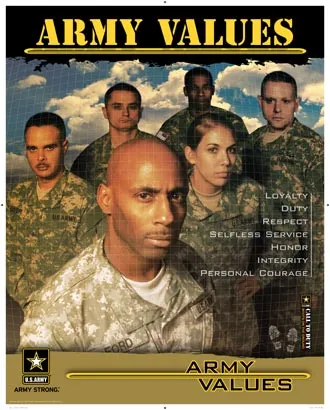
Courtesy of US Army
Editor: Erind Pajo
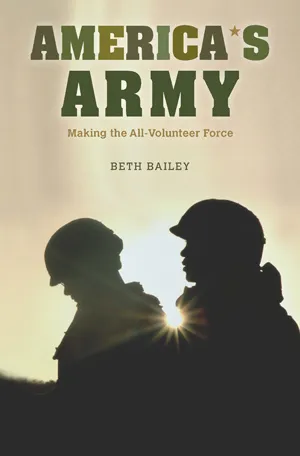
America's Army
Beth Bailey America's Army: Making the All-Volunteer Force Belknap Press of Harvard University Press 352 pages, 9 ½ x 6 ½ inches ISBN 978 0674035362
Available here →March 19, 2010
20100319-bailey-beth-on-america-army-making-all-volunteer-force-2
The wide angle
The rest of this thread

Joe Labolito, Temple University
Beth Bailey
Beth Bailey, professor of history at Temple University, is a social/cultural historian of the 20th century United States. Besides America’s Army, featured in her Rorotoko book interview, Bailey is the author of From Front Porch to Back Seat: Courtship in 20th Century America, The First Strange Place: Race and Sex in World War II Hawaii (with David Farber), and Sex in the Heartland, and also co-author of the American history survey text, A People and a Nation. Her research has been supported by fellowships from the Woodrow Wilson Center for International Studies, the National Endowment for the Humanities, and the American Council of Learned Societies.
Pull this thread
The US military confronted the legacies of the civil rights struggles more directly than the universities or the courts.
Know something the rest of us don't?
Most threads on Rorotoko begin with our invitation. Any thread can begin with a proposal: you write it with the same prompts every thread answers, and we review it.
Propose a thread →