
Beth Bailey
America's Army
If someone began thumbing randomly through this book, I’d hope that it would fall open to page 168–not because that’s where I make a particularly powerful point or lay out my argument, but because it was so much fun to write. It comes near the end of a chapter titled “If you like Ms., You’ll Love Pvt.” (taken from a late 1970s recruiting ad). In this chapter, I argue that the labor-market model essentially created a structural imperative to increase the number of women in the Army, most particularly in “nontraditional” military occupational specialties (MOSs).
But commanders and policy makers, in their attempts to attract women volunteers, relied heavily on lessons learned during World War II, when women servicemembers were frequently portrayed as sexually promiscuous floozies or Amazons with “unnatural” interests. Well into the 1970s, recruiting attempts stressed old-fashioned notions of respectability, femininity, and excellent prospects for marriage. This presented a bit of a problem: If you want to attract women who want to fix trucks, emphasizing femininity is probably not the best strategy. Pushed by personnel needs, those with authority to do so made a serious attempt to recast the portrayal of women in the army, turning to a language of women’s liberation in all its 1970s inconsistencies and complexities.
Through most of the 1970s, women’s expanding roles were supported by Congress. The Senate passed the Equal Rights Amendment with a vote of 84 to 8 in 1972, in 1975 Congress voted to open all military academies to women, and by the end of the decade—with the first women scheduled to graduate from the nation’s military academies in 1980—the House Armed Services Committee was holding hearings on the use of women in combat.
By the late 1970s, members of Congress were feeling pressure—or finding support—from a growing conservative movement that opposed government-mandated equality and argued that Americans should hold to timeless truths and traditional values that defined the differences between men and women. These hearings reflect that change. I describe the testimony of Mrs. Tottie Ellis of the Eagle Forum, who argued that women were not suited for combat because combat is “violent and dehumanizing. . . in fact, men I have known who were in combat do not even enjoy war movies.” Jeremiah Denton, co-founder of the Coalition for Decency, linked women in the military to “godless Sodom and Gomorrah poison” and psychiatrist Harold Voth testified that women’s “search for an identity and role which permits them to live out a pseudo-male identity” which had led to “social pathology” and national decline.
And if the book happened to fall open one more time, I’d root for page 236. It’s a description of the Army of One recruiting campaign and reactions to it. While criticism of the new campaign came hard and fast (“Has anyone considered,” asked one noted military sociologist, “that ‘An Army of One’ isn’t likely to scare potential enemies?”) and the slogan proved short-lived, no one seems to have understood the logic behind it. The images of Corporal Lovett running through the desert in the commercial that premiered in January 2001, along with the entire “An Army of One” campaign, were parts of an attempt at rebranding. This army wasn’t about benefits and opportunity, not about money for college or the chance to learn computer skills. This was an army of warriors in training. The army’s current emphasis on the “warrior ethos” began well before the attacks of 9/11, and it had very different origins.
In the mid-1950s the majority of adult men in the United States were veterans. Today that percentage (male and female) is less than thirteen. That is in large part for a positive reason: no ground war has been fought by mass armies in recent decades. But because the all-volunteer force has long been drawn from a small and relatively self-contained portion of the American population, a huge number of Americans—including many of those most likely to buy works of serious non-fiction—have no significant contact with anyone in military and know little to nothing about it.
Some of the most important and most difficult questions we face as a nation seem to require a basic understanding of America’s military. I hope this book will give those readers a clearer understanding of the contemporary military and its recent history, knowledge that they can use to make their own arguments about the nation’s future.
I also hope, in the wake of the war in Iraq and the current escalation in Afghanistan, that this book contributes to a national discussion about what it means to fight an extended war in which a small number of men and women bear the burden of military service while most of the nation is asked no sacrifice. In most ways, such a discussion is moot. Short of massive, total war, the United States is not likely to reinstate the draft. There is little public desire; there is no political will. The military has become a powerful advocate for the volunteer force, and in practical terms most analysts agree that a volunteer force provides best for the defense of the nation. Perhaps the reinstitution of the draft (a lottery system with very limited exemptions?) would constrain American military adventurism–but that was precisely the argument the opponents of the Vietnam War made for moving to a volunteer force in the first place.
None of the answers are easy, but the moral complexities need to be acknowledged and debated. In the end, I argue, an institution that once seemed mired in crisis has achieved remarkable successes, both as purveyor of military force and as provider of social good. Nevertheless, in a democratic nation, there is something lost when individual liberty is valued over all and the rights and benefits of citizenship become less closely linked to its duties and obligations.
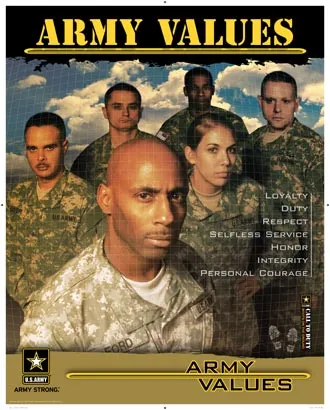
Courtesy of US Army
Editor: Erind Pajo
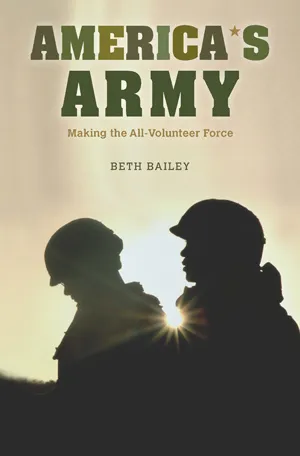
America's Army
Beth Bailey America's Army: Making the All-Volunteer Force Belknap Press of Harvard University Press 352 pages, 9 ½ x 6 ½ inches ISBN 978 0674035362
Available here →March 19, 2010
20100319-bailey-beth-on-america-army-making-all-volunteer-force-3
A close-up
The rest of this thread

Joe Labolito, Temple University
Beth Bailey
Beth Bailey, professor of history at Temple University, is a social/cultural historian of the 20th century United States. Besides America’s Army, featured in her Rorotoko book interview, Bailey is the author of From Front Porch to Back Seat: Courtship in 20th Century America, The First Strange Place: Race and Sex in World War II Hawaii (with David Farber), and Sex in the Heartland, and also co-author of the American history survey text, A People and a Nation. Her research has been supported by fellowships from the Woodrow Wilson Center for International Studies, the National Endowment for the Humanities, and the American Council of Learned Societies.
Pull this thread
The US military confronted the legacies of the civil rights struggles more directly than the universities or the courts.
Know something the rest of us don't?
Most threads on Rorotoko begin with our invitation. Any thread can begin with a proposal: you write it with the same prompts every thread answers, and we review it.
Propose a thread →