
Alice Echols
Hot Stuff
Histories of disco emphasize the antagonism between rock and disco, and with good reason. Rock publications covered the glitter-ball world begrudgingly and/or sneeringly. Rock radio was even more hostile. Punk rockers, in particular made a point of attacking disco. And yet as I listened again to the music of that era I was struck by how deeply disco penetrated particular corners of punk. Punk’s penchant for fitful rather than groovy rhythms, un-soulful vocals, choppy, harsh sounding guitars, and the sonically stripped-down made its incorporation of disco sounds and techniques unlikely. Unsurprisingly the earliest dance-rock hybrids were often spoofs of disco. “Fodderstompf” by PiL, fronted by ex-Sex Pistol John Lydon, is one such track.
“Fodderstompf” was a 7:46-minute prank meant to cause maximum offense. The track grew out of PiL’s recording sessions for their first album, 1978’s First Issue. Looking for a way to meet their contractual obligation to Virgin Records—thirty minutes of music—PiL hit on the idea of recording a long, obnoxious song to finish off their album. The cut consists of little more than their screeching like Terry Jones, Monty Python’s spam-serving waitress, over an unchanging, thunderous funk bass line set to a snare-heavy disco beat. You can hear Jah Wobble talking in the background about wanting to complete the record with minimal exertion, which he notes, “we are now doing very suc-cess-fully.” Band members rattle on about going out for cigarettes, mumble about the song’s tediousness, and urge listeners to be boring. Those who persevered to the end were told that they were as “sad” as the band churning out this drek.
The cut was guaranteed to piss off their record label as well as Pistols’ fans unprepared for music that so violated punk’s conventions of speed and economy. Like other punks in the “Disco Sucks” period who were experimenting with danceable sounds, PiL gave themselves an out: “Fodderstompf” was a spoof of disco. Journalist Simon Reynolds observed that it was almost a parody of Donna Summer’s “Love to Love You Baby.” Its German-sounding title alone suggested inferior material, stomping beat, “stumpf” (meaning numb or blunt), and perhaps the German penchant for the mechanistic, as in Kraftwerk and Giorgio Moroder, aka the Munich Machine. As for the lyrics, the track’s whining cries of wanting “to be loved” mocked disco’s faith in the restorative power of “love” (“Love’s Theme,” “Love Train,” “Love is the Message,” “I Love Music,” etc.).
Designed to be off-putting, “Fodderstompf” proved unexpectedly compelling, even to those it apparently meant to disparage. Legend has it that the song ended up being played at Studio 54 where dancers would scream along with its manic chorus, “We only wanted to be loved!” Over the years critics and fans have rhapsodized about the song’s bass line. PiL bassist Wobble admitted that it was in its own way “as mental as Funkadelic.” (George Clinton’s P-Funk crew likely influenced PiL, but “Hydraulic Pump,” the 1983 collaboration between P-Funk and Sly Stone, sounds like “Fodderstompf.”) Moreover, far from being a one-off, “Fodderstompf” prefigured PiL’s embrace of dance music. Their next LP, 1979’s critically acclaimed Metal Box, found the band further developing their “anti-rock & roll.” Soon Lydon was shocking former fans with the news that the only music he really liked was disco, and that PiL was actually a dance band.
How did they become disco converts? Reggae was certainly one route into dance music. PiL were “total dub fanatics.” Lydon’s characterization of London’s reggae clubs emphasizes the high-volume bass, whose physicality, he writes, “just left me gobsmacked.” Lydon and his friends had also been going to gay bars for years to avoid “boot boy harassment” and because these underground clubs “always had the best records.” In the late 1990s Lydon admitted that he had “loved disco” and saw “no shame at all in admiring the Bee Gees and being a Sex Pistol.” He was never an Abba fan, but two other Pistols—Sid Vicious and Glen Matlock—were. Matlock’s original riff for the Pistols’ “Pretty Vacant” drew upon an unlikely source: Abba’s “SOS.” In certain punk circles, then, “Disco Sucks” may have been little more than a pose.
Obviously I would like to see Hot Stuff spark further discussion about disco—which is all over today’s charts, even if it isn’t called disco.
The book challenges the stereotypical view of disco as the encapsulation of the Me Decade—hedonistic, narcissistic, and forgettable. But it also questions the depiction of disco emerging in what I call “disco studies.” Too much disco revisionism is driven by an effort to debunk the pervasive view of disco as crassly commercial, exclusionary, and politically regressive. The result is work that overemphasizes disco’s subcultural purity, democratic beginnings, and transgressive practices.
Mind you, I agree with parts of this analysis. But it follows too faithfully the usual narrative whereby an inventive underground (it could be rap, punk, or disco) is eclipsed by its debased commercial version. The result is a two-tier schema of “good” versus “bad” disco that creates all sorts of distortions, including the by-now routine disparagement of Saturday Night Fever, a movie I discuss at some length.
Just as importantly I want Hot Stuff to build on the work of other historians who have been chipping away at the usual view of the seventies as a time when nothing happened, or nothing good happened. According to this view the Disco Years are an era memorable for America’s hapless presidents, declining prestige, bad fashions, ludicrous music, and over-the-top narcissism. However, in these years small but growing numbers of African-Americans entered the ranks of the middle class, women moved into the workplace and nightlife, and gays vacated the shadowy margins of American life.
Disco’s One Nation Under a Thump impulse succeeded in integrating American nightlife to an extent unthinkable just a decade earlier. Pornography began moving out of seedy red-light districts and into respectable businesses—and into American homes—as a result of video technology. The explosion of pornography, the resurgence of feminism, the ready availability of the birth-control pill, the legalization of abortion, and disco itself re-made America’s sexual landscape in ways that created unprecedented (and sometimes risky) possibilities of sexual pleasure for women. Meanwhile the feminist assault on masculine privilege, defeat in Vietnam, de-industrialization, and affirmative action posed challenges for American men. As I hope Hot Stuff demonstrates, the 1970s were, in fact, the combustible years.
Editor: Erind Pajo
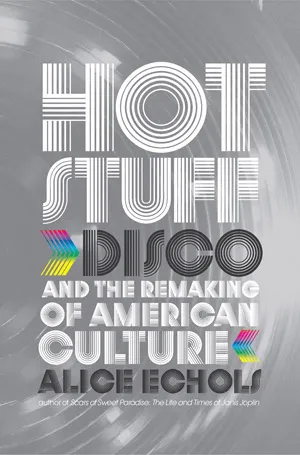
Hot Stuff
Alice Echols Hot Stuff: Disco and the Remaking of American Culture W. W. Norton 338 pages, 9 ½ x 6 ½ inches ISBN 978 0393066753
Available here →March 29, 2010
20100329-echols-alice-hot-stuff-disco-remaking-american-culture-3
A close-up
The rest of this thread

Alice Echols
Alice Echols is Professor of American Studies and History at Rutgers University. As a graduate student at the University of Michigan, she engaged in dissertation-avoidance by moonlighting as a disco/funk deejay. Besides Hot Stuff, featured in her Rorotoko book interview, Alice Echols is the author of Scars of Sweet Paradise: The Life and Times of Janis Joplin, Daring to Be Bad: Radical Feminism in America, 1967-75, and Shaky Ground: The Sixties and Its Aftershocks. Now she is writing a book about a Depression-era family scandal involving her maternal grandfather, a banker.
Pull this thread
Disco broadened blackness, femininity and male homosexuality, and without it there is no route from Diana Ross to Lil' Kim.
Know something the rest of us don't?
Most threads on Rorotoko begin with our invitation. Any thread can begin with a proposal: you write it with the same prompts every thread answers, and we review it.
Propose a thread →