
Joshua Shannon
The Disappearance of Objects
Probably the part of the book I like best is the chapter on Donald Judd’s Minimalist sculptures; if someone were to casually flip through and land on a section to read, I’d want it to be the end of this last chapter and then the book’s short conclusion.Judd’s art has lately been understood primarily as a resistance to depiction: his simple metal boxes don’t represent anything, they insist instead on simply being there. This interpretation is based on Judd’s own remarks, and I think it is right. What I found in my research, though, is that Judd and his early critics (and this seems to be a contradiction) also thought about his work in relationship to architecture, shipping, computers, and so on.
I became really interested in trying to think both of these things at once: Judd’s work is totally independent of reference and, at the same time, deeply influenced by the contemporary landscape. “I don't much like the idea of representing the United States in my work,” Judd once told an interviewer in the sixties, “It's just that you live here and you are involved in your sense of what's around you.”
I became especially interested in an ambivalence or dialectic in Judd’s work (perhaps easiest to see in the works before his Minimalist boxes) between an aesthetic of abstraction, modularity, and systematicity, on the one hand, and a traditional, sometimes even gummy aesthetic of palpable materiality, on the other. This fact helped me to see that a similar dialectic was then at work in New York, too—even on the section of Fourth Avenue beneath Judd’s windows: the city was caught between a new fantasy of the frictionless, globally interconnected provision of services and an old industrial landscape of manual labor and quirky architecture.
As he moved on to making his sculptures by ordering metal boxes from a sheet-metal shop, Judd said he wanted the works to be hand-made, but to look as if they had been “stamped-out.” He was ambivalent about whether to refer to his fabricators, Bernstein Brothers Sheet Metal Specialties, with the antiquated term “tinsmiths,” or instead to call them, somewhat grandiosely, a “factory.”
What I seek to do at the end of the chapter is to connect these tensions in the city’s character to the vocabulary that animated art criticism throughout the postwar decades. I think I have discovered that terms and problems that seemed purely to belong to the realm of the art discourse were in fact so bitterly contested precisely because they were also ways of thinking about the changing texture of New York, even of contemporary life. For a fuller explanation, you’ll have to read the book!
I would be pleased if The Disappearance of Objects could make a few different kinds of contributions.On one level, of course, I simply hope to give readers a means to complicate and enrich their encounters with the art works discussed. I hope, too, that the book will change the way we think about art in the postwar decades, by helping us to understand that the problems and ideas of late modernist art were deeply intertwined with the changing quality of everyday life.
By extension I hope that this book can serve as an example for a new kind contemporary art history—one that combines the theoretical interests that usually dominate the field with the weight and flavor of historical specificity.Above all, I think we need to be able to think really closely about art while thinking equally closely about history. I would be especially gratified if historians took up the book as an account of the ways in which our experiences of ordinary space have changed with the rise of the postmodern economy.
Editor: Erind Pajo
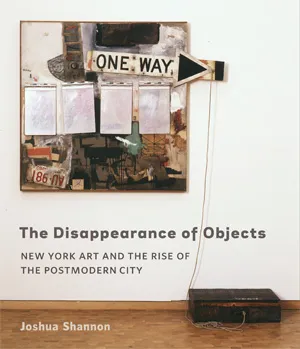
The Disappearance of Objects
Joshua Shannon The Disappearance of Objects: New York Art and the Rise of the Postmodern City Yale University Press348 pages, 9 ¾ x 8 ¼ inches ISBN 978 0300137064
Available here →April 5, 2010
20100405-shannon-joshua-on-disappear-objects-new-york-art-postmodern-city-3
A close-up
The rest of this thread
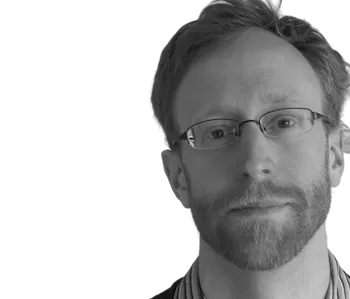
Joshua Shannon
Joshua Shannon is Assistant Professor of contemporary art history and theory at the University of Maryland. In 2009-10, he holds the Terra Visiting Professorship of American Art at the Freie Universität Berlin, where he is working on a new book called The Recording Machine: Photography and Realism since the 1960s.
Pull this thread
The difficult New York art of around 1960 was an attempt to understand the city's deindustrialization.
Know something the rest of us don't?
Most threads on Rorotoko begin with our invitation. Any thread can begin with a proposal: you write it with the same prompts every thread answers, and we review it.
Propose a thread →