
Erin Manning
Relationscapes
A reader encountering Relationscapes in a bookstore might find themselves attracted to the front cover, which is a reproduction of a painting by Australian Aboriginal artist Emily Kngwarreye. This might lead her to open the book to the chapter on mapping as it functions in Aboriginal culture. In this chapter, I take a close look at the work of both Clifford Possum and Emily Kngwarreye, two contemporary Aboriginal artists.
To paint the landscape with acrylics is a relatively new form of art for the Aborigines of Australia. Until the early 1970s, stories of land and spirit were evoked mostly through other media—sand, bark, wood. The paintings produced since then are all associated with Dreamings—Jukurrpa—which are an integral aspect of life in Central Desert society. Stories told for more than 50,000 years of continuous history, Dreamings not only speak about the landscape and its vicissitudes, they create spacetimes of experience.
For Aborigines, life is Dreaming in the sense that the coordinates of spacetime out of which everyday lives emerge are significantly in line with creation and recreation of the land and its laws (which is one of the translations of Dreaming). The land is not an extension of the Aborigines—it is them. To be the land is to become in relation to it, in relation not to space itself, but to the living coordinates of a topological relationscape that embodies as much the law as it does the grains of sand that prolong it in real-time.
Clifford Possum is significant both in the history of contemporary Aboriginal art and in terms of what Relationscapes attempts to convey.
One of the foci of this chapter is Possum’s so-called “map series.” In this series, Possum paints the Dreamings for which he is custodian (Dreamings are managed through complex kinship ties), completing a number of paintings that “map” the large areas and stories the Dreamings conjure. In terms of movement-moving, it is perhaps most noteworthy in these paintings that Clifford Possum does not adhere to a Euclidean set of coordinates for his map.
He paints them while moving around the canvas lying on the ground. This results in a continuously shifting perspective that might astound those of us who organize landscapes into grids. In Aboriginal culture, the landscape—and the Dreamings that activate it—are always experiential. The landscape is never observed from outside its eventness, nor is it painted as though it had stopped moving.
In my work, Relationscapes has opened the way for the continued exploration of the relationship between microperception and micropolitics.
It has also introduced me to a growing group of philosophers, artists, dancers, activists whose concerns—both aesthetic and political—are in tune with the propositions Relationscapes calls forth.
This has fed my work as director of the SenseLab, which, with a large array of international and local collaborators, organized an event in 2009 called Society for Molecules, and is planning a next event for July 2011, Generating the Impossible. At SenseLab, I seek to allow for a wide regrouping of collectives and individuals who similarly are impatient to create modalities of existence and thought that propose more creative ways of working academically and in the art world.
Editor: Erind Pajo
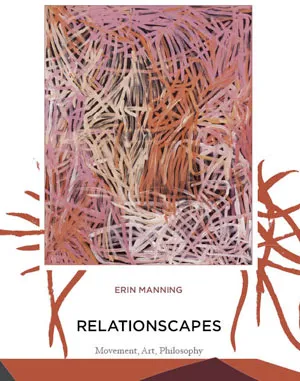
Relationscapes
Erin Manning Relationscapes: Movement, Art, Philosophy MIT Press 272 pages, 9 x 7 inches ISBN 978 0262134903
Available here →April 14, 2010
20100414-manning-erin-relationscapes-movement-arts-philosophy-3
A close-up
The rest of this thread

Erin Manning
Erin Manning holds a University Research Chair in Relational Art and Philosophy in the Faculty of Fine Arts at Concordia University in Montreal, Canada. She is also the director of SenseLab, a laboratory that explores the intersections between art practice and philosophy through the matrix of the sensing body in movement. In her art practice she works between painting, fabric and sculpture. Besides Relationscapes, featured in her Rorotoko book interview, Manning is the author of Politics of Touch: Sense, Movement, Sovereignty (University of Minnesota Press, 2007) and Ephemeral Territories: Representing Nation, Home and Identity in Canada (University of Minnesota Press, 2003).
Pull this thread
All movement is already relational, composing spacetimes rather than crossing space.
Know something the rest of us don't?
Most threads on Rorotoko begin with our invitation. Any thread can begin with a proposal: you write it with the same prompts every thread answers, and we review it.
Propose a thread →