
Dalia Judovitz
Drawing on Art
The idea that the meaning of art may not be exhausted by its visual manifestations and the desire to look is examined as a response to the pressures of commodification implied in the emergence of public exhibition and market forces in the late 19th century.
I show that Duchamp’s readymades inaugurated the shift from the idea of capitalizing on the object’s visual appearance to exposing and playing on its modes of public presentation and display.
But what is art when “looks” no longer count? I argue that rather than enacting the negation and ultimate abandonment of painting, as most critics have contended, the readymades demonstrate the impossibility of defining art.
Coupling the ideas of art and anti-art in a dynamic play, their back and forth movement will mark their impasse (or “draw”) with painting, alluding to its postponement as visual expression and its continued promise as a conceptual enterprise.
It is in terms of this dynamic play that the readymades will emerge as paradigmatic of Duchamp’s later works, ranging across experiments in optics (windows, glass, and mirrors), in film, chess, and installation works. Conflating artistic and critical activities, these later works will conceptually question the meaning of art while outwitting the necessity for its physical manifestations.
They will continue to attest to the impossibility of defining art even as they irrevocably demonstrate the necessity of moving beyond its visual impulse.
The impossibility of defining art once and for all may convince us of the viability—indeed, of the necessity—of no longer trying to do so.
If one accepts the legitimacy of the claim that not trying to define art is an acceptable premise, then this lack of a founding definition will not foreclose debate and dissent about its nature; it will invite and drive them.
What Duchamp (along with his Dada co-conspirators Picabia and Man Ray, and his Surrealist counterpart and sometime collaborator Dali) preserved and indeed reserved for postmodernism is an idea of art understood no longer as visual essence or expression but as locus of dissent and disparity of opinion. It is this modernist legacy that later collaborators such as Baj and/or postmodern appropriators such as Matta-Clark and Wilson drew upon and critically took to task.
The emphases of their works shifted away from the production of objects to the manipulation of the contexts that frame the idea of art in order to expose the institutional scaffolding that props up the possibility of meaning ascribed to works of art.
I argue that such an understanding of art no longer belongs to the realm of aesthetics alone, since it brings into play through its activation and engagement with spectatorship questions of responsibility and ethics.
Drawing on Art: Duchamp and Company shows how the idea of art, insofar as it relies on the works of the past not just as resource but as the springboard for the emergence of postmodernism, can become critical fuel for artistic impetus.
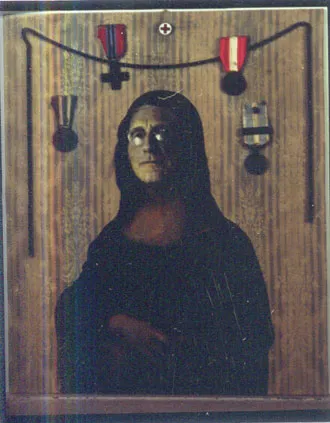
Enrico Baj. Homage to Marcel Duchamp. 1987. 55 x 46 cm. © Roberta Baj, 2008. (Image reproduced courtesy of Roberta Baj.)
Editor: Erind Pajo

Drawing on Art
Dalia Judovitz Drawing on Art: Duchamp and Company University of Minnesota Press 288 pages, 8 1/2 x 5 1/2 inches ISBN 978 0816665303
Available here →May 5, 2010
20100505-dalia-judovitz-on-drawing-on-art-duchamp-company-3
A close-up
The rest of this thread
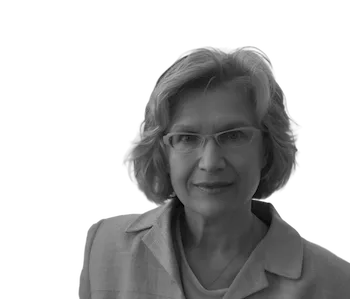
Dalia Judovitz
Dalia Judovitz is National Endowment for the Humanities Professor of French at Emory University. Born in Transylvania, Romania, she was educated in the United States and France. Besides Drawing on Art, featured in her Rorotoko interview, her publications in the field of modern art and postmodern aesthetics include Unpacking Duchamp: Art in Transit (1995) and Déplier Duchamp: Passages de l’art (2000). Her other area of research focuses on questions of subjectivity, representation and the body in early modern texts, and she is author of Subjectivity and Representation in Descartes: The Origins of Modernity (1988) and The Culture of the Body: Genealogies of Modernity (2001). She is also the co-editor of Dialectic and Narrative (1993), and of the book series The Body, in Theory: Histories of Cultural Materialism (University of Michigan Press, 1994-2004).
Pull this thread
The readymades do not abandon painting, they show that art cannot be defined at all.
Know something the rest of us don't?
Most threads on Rorotoko begin with our invitation. Any thread can begin with a proposal: you write it with the same prompts every thread answers, and we review it.
Propose a thread →