
Dalia Judovitz
Drawing on Art
The book’s title Drawing on art: Duchamp and Company refers to Marcel Duchamp’s literal defacement of the Mona Lisa image—and also to its figurative meaning, the treatment of art as an idea from which to draw inspiration.
This study shows how the idea of art became the critical fuel and springboard for new endeavors that challenge the meaning of art and of authorship. The deactivation of art’s visual mandate that emerged from the critique of the commodity and market forces, inaugurated by the readymades, opened up the possibility of questioning art’s premises and its social and cultural manifestations.
I argue that rather than negating or abandoning art, the readymades demonstrate the impossibility of defining it in the first place. They transform art into a resource for critical debate. To draw on art is to also to draw on other artists, which brings questions of creativity and artistic influence into play.
The idea that the onlooker also “makes” the work of art activates the productive potential of the spectator’s consumption.
In addition to some analyses of Duchamp’s own works, the book provides detailed interpretations of works by other figures: those who proved influential on Duchamp’s thought and collaborated with him during the Dada and Surrealist period (notably Francis Picabia, Man Ray, and Salvador Dali), and those who later appropriated and redeployed these gestures by playing out their conceptual implications (Enrico Baj, Gordon Matta-Clark and Richard Wilson).
I suggest that all artistic production may be appropriative insofar as artists, in attempting to produce new works, necessarily draw on other works and other artists.
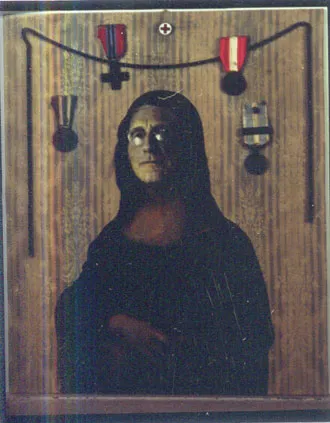
Enrico Baj. Homage to Marcel Duchamp. 1987. 55 x 46 cm. © Roberta Baj, 2008. (Image reproduced courtesy of Roberta Baj.)
Editor: Erind Pajo

Drawing on Art
Dalia Judovitz Drawing on Art: Duchamp and Company University of Minnesota Press 288 pages, 8 1/2 x 5 1/2 inches ISBN 978 0816665303
Available here →May 5, 2010
20100505-dalia-judovitz-on-drawing-on-art-duchamp-company-1-1
In a nutshell
The rest of this thread

Dalia Judovitz
Dalia Judovitz is National Endowment for the Humanities Professor of French at Emory University. Born in Transylvania, Romania, she was educated in the United States and France. Besides Drawing on Art, featured in her Rorotoko interview, her publications in the field of modern art and postmodern aesthetics include Unpacking Duchamp: Art in Transit (1995) and Déplier Duchamp: Passages de l’art (2000). Her other area of research focuses on questions of subjectivity, representation and the body in early modern texts, and she is author of Subjectivity and Representation in Descartes: The Origins of Modernity (1988) and The Culture of the Body: Genealogies of Modernity (2001). She is also the co-editor of Dialectic and Narrative (1993), and of the book series The Body, in Theory: Histories of Cultural Materialism (University of Michigan Press, 1994-2004).
Pull this thread
The readymades do not abandon painting, they show that art cannot be defined at all.
Know something the rest of us don't?
Most threads on Rorotoko begin with our invitation. Any thread can begin with a proposal: you write it with the same prompts every thread answers, and we review it.
Propose a thread →