
Enda Duffy
The Speed Handbook
Adrenaline was isolated by Jokicki Takamine in 1901. And it was at once described in terms of human energy, of movement, as “fight or flight,” as the source of increased alertness. The automobile, at almost the same moment, become the technology with which one’s alert reflexes, powered by adrenaline, could be tested and exercised.
Both the new technology and the new drug (for adrenaline was synthesized and marketed soon after) were part of a new cultural interest at this moment in human energy. In the case of the car, it was as if the new technology as prosthesis involved such a display of mechanic energy and speed that the human organism felt the need to measure up.
Both adrenaline and automobile speed thrills are symptoms of the new role of energy at this moment in the very definition of human life itself. Just as there is a history of slowness as well as a history of speed, a history of human energy too remains to be written. The turn of the century moment that saw the isolation and description of the role of adrenaline is a key transformative moment in that history.
Though I barely use the word in the book, I hope The Speed Handbook contributes to the growing field of biopolitics.
By “biopolitics” I mean the ways in which, in modernity, various powers, such as—but not only—the state, have progressively made the human body, its well-being, and its very life, the subject of their attention. Clearly, technology and science, as well as culture, have played a huge role in the advance of a politics of “bios.”
In other words, it is not enough that those in power influence what we think; there is even more at stake in controlling our bodies, and in controlling life itself. Our sense of our own bodies, the variations of our affective lives as well as our emotional states and moods, even our reflexes, are more intertwined in power networks, and networks of production and consumption, than ever.
In this enmeshing, the moment in the 20th century when human speed thrills were vastly enhanced by technology marks a striking new development. Seduced by speed and the joys of adrenaline, the modernist subject, as she accelerated to the unprecedented personal speeds of forty- five miles per hour, learned how to gauge her alertness and intensity in cohabitation with the machine. The state, with its speed limits and traffic laws, was on hand to monitor this new techno-enabled freedom.
Human energy, as biopolitical resource, was being recalibrated in relation to machine power. Movement—at any speed—was enshrined as the basic sign of nothing less than life. And we all had access to a new pleasure, a thrill not known to our ancestors, and a certain freedom to use it, a characteristic thrill of the modernist era which can still teach us lots about what it means to be modern.
Editor: Erind Pajo
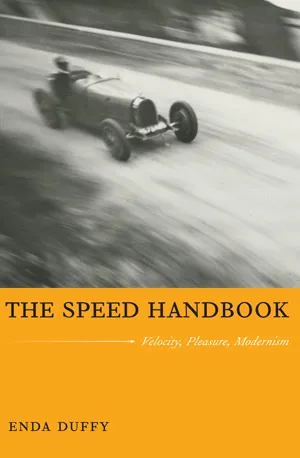
The Speed Handbook
Enda Duffy The Speed Handbook: Velocity, Pleasure, Modernism Duke University Press 320 pages, 9 1/4 x 6 inches ISBN 978 0822344421
Available here →May 24, 2010
20100524-duffy-enda-on-speed-handbook-velocity-pleasure-modernism-3
A close-up
The rest of this thread

Enda Duffy
Enda Duffy is the author of The Subaltern Ulysses, as well as The Speed Handbook, featured in his Rorotoko book interview. He received his Ph.D. in English and American Literature from Harvard, and taught at Reed College and Wesleyan University before coming to the University of California at Santa Barbara, where he is now Professor of English and co-director of COMMA, the Center on Modernism, Materialism and Aesthetics.
Pull this thread
Speed is modernity's one genuinely new pleasure, and modernist art responds to its thrill, not to alienation.
Know something the rest of us don't?
Most threads on Rorotoko begin with our invitation. Any thread can begin with a proposal: you write it with the same prompts every thread answers, and we review it.
Propose a thread →