
Enda Duffy
The Speed Handbook
The Speed Handbook is first and foremost devoted to exploring the thrill you feel when you experience intense new speeds.
Of what, exactly does the thrill of speed consist? Can speed’s excitement be harnessed and redeployed to energize the ways we live?
I suggest that this is exactly what happened for the first time in the modernist era, when the speed of the newly invented automobile allowed people at last to feel modernity in their very bones.
The Speed Handbook argues that access to intense new speeds for masses of people, with the arrival of the automobile and its instant acceptance, is a crucial sign of a new level if intensity that was offered to people in modernity.
Speed revolutionized people’s sense of space and territory. It gave drivers a sense of how, through this new technology, they might live their lives more intensely. It introduced them to new levels of physical risk and the powers of technologized violence: the crash. It placed them, even in their leisure moments, ever more fully under the surveillance of the law.
The modernist era, which followed the invention of the mass-producible motor car after 1896, marked a new regime of personal thrill-reward, personal risk and personal responsibility, all centered on offering masses of people access to hitherto-incredible speeds.
Editor: Erind Pajo
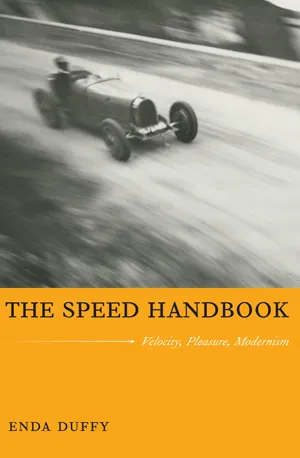
The Speed Handbook
Enda Duffy The Speed Handbook: Velocity, Pleasure, Modernism Duke University Press 320 pages, 9 1/4 x 6 inches ISBN 978 0822344421
Available here →May 24, 2010
20100524-duffy-enda-on-speed-handbook-velocity-pleasure-modernism-1-1
In a nutshell
The rest of this thread
Enda Duffy
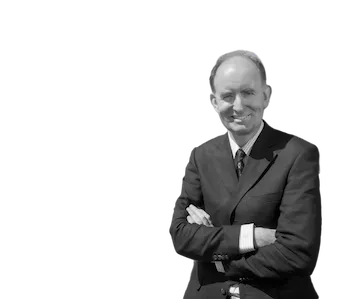
Enda Duffy is the author of The Subaltern Ulysses, as well as The Speed Handbook, featured in his Rorotoko book interview. He received his Ph.D. in English and American Literature from Harvard, and taught at Reed College and Wesleyan University before coming to the University of California at Santa Barbara, where he is now Professor of English and co-director of COMMA, the Center on Modernism, Materialism and Aesthetics.
Pull this thread
pulls againstpulls alongside
Speed is modernity's one genuinely new pleasure, and modernist art responds to its thrill, not to alienation.
Against WC · The Internet, a control technology, passed as a medium of freedom because freedom and control had been coupled. On: Technology causes the social changes attributed to it
Against GB · Early American cinema's handling of race ran on the Picturesque, inherited from painting, prints and photography. On: Technology causes the social changes attributed to it
Against MK · The automaton fascinates because an artificial thing that acts alive breaches the living/dead binary, so delight and horror arrive together. On: Technology causes the social changes attributed to it
Alongside MK · The card index, not the book, is the direct precursor of the computer. On: Technology causes the social changes attributed to it
Alongside IH · Humans head toward ever more stuff because when things fail the fix is more things, and that cannot be reversed. On: Technology causes the social changes attributed to it
Alongside JL · Early modern England's dominant metaphors came from books rather than the theatre, and they composed thought, whiteness included. On: Technology causes the social changes attributed to it
Nearby AM · The idea of robots is ancient, and Hesiod's Talos, with inner workings and a power source, qualifies as one.
Know something the rest of us don't?
Most threads on Rorotoko begin with our invitation. Any thread can begin with a proposal: you write it with the same prompts every thread answers, and we review it.
Propose a thread →