
Heather Cox Richardson
Wounded Knee
While the final paragraph of the introduction is perhaps the best synopsis of the book’s argument (page 18), my favorite paragraph in the book is on page 277.
This paragraph tells the story of what the men in the burial party found in the council area when they went back to it a day or so after the massacre. What they found was horrific, of course, but the paragraph does more than simply describe carnage; it carries the weight of one of the strongest themes of the book.
Years later, the men who saw the council area before the bodies were removed remained haunted by what they saw: women, girls, and babies, who, torn by bullets, had crawled together to die in each other’s arms.
The story in Wounded Knee is a story of political maneuvering and military campaigns, spheres in which women in 1890 had very little voice. The men who designed economic policies and fought over patronage, launched military campaigns and supplied troops, did so in a world that they held separate from the world of wives and homes and babies. Politicians and businessmen insisted they were protecting their dependents, doing what was best for them, but they made decisions according to an economic theory that focused on men.
When writing Wounded Knee, I was careful to keep that focus on the men’s world. Women very rarely appear, and then only incidentally.But the point of the book is that national policies and national political rhetoric matter, and they matter on a very personal level. While President Harrison and General Miles and Sitting Bull were arguing about economics and voters and troops, women were trying to feed their children, and to protect them. For all the righteous language of the midterm campaign, what really mattered in the end was that people died.
Women and children who had had no say in any of the debates that led to the events of December 29, 1890 were murdered. And in their extremity, fearfully wounded mothers and daughters clung to each other so they could die together.Women are there throughout Wounded Knee, but they are invisible. The one place they become visible is that paragraph on page 277. And in that one paragraph, I think, they balance—and trump—everything else in the book.Wounded Knee shows that we must reject extreme political rhetoric.
Leading up to the 1890 midterm election, Republicans refused to admit that their policies were not working for many Americans. Rather than addressing the legitimate concerns of farmers and workers, they accused them of being “socialists” who wanted to destroy the nation. Having defined a Democratic victory as the end of America, the Republicans made it imperative that they win, no matter the cost.In the short term, that cost was a massacre that left more than 250 people dead.
The Republicans’ conviction that they must win to save America had longer term consequences, as well. During the Harrison administration, officials added six new western states to the Union to increase their power in the Senate, sowed the seeds for draconian voter purges, committed the government to a western policy that dramatically changed the western environment, and undercut the ability of the Sioux to participate in the American economy in the future. These efforts dramatically reshaped the nation, and we still live with their consequences.
Today we deplore what happened at Wounded Knee Creek. But we must recognize that what made it possible was extreme political rhetoric. Beyond “racism,” it was the accusation of political opponents as being un-American that made any action acceptable so long as it would achieve political goals.
So long as we accept hyperbolic political rhetoric and reward the politicians who use it, we are laying the groundwork for other disasters.
Editor: Erind Pajo
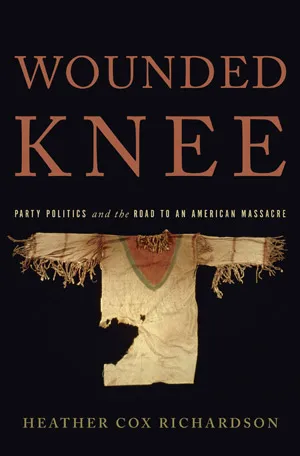
Wounded Knee
Heather Cox Richardson Wounded Knee: Party Politics and the Road to an American Massacre Basic Books392 pages, 9 ¼ x 6 ½ inches ISBN 978 0465009213
Available here →June 7, 2010
20100607-richardson-heather-on-wounded-knee-party-politic-american-massacre-3
A close-up
The rest of this thread

Greg Anthony
Heather Cox Richardson
Heather Cox Richardson is a professor of history at University of Massachusetts, Amherst. Besides Wounded Knee, featured in her Rorotoko interview, she is the author of a number of other books on late nineteenth-century America, including The Death of Reconstruction: Race, Class, and Politics, 1865-1901, and West from Appomattox: The Reconstruction of America after the Civil War.
Pull this thread
Wounded Knee happened because control of the U.S. Senate hung on one contested South Dakota seat.
Know something the rest of us don't?
Most threads on Rorotoko begin with our invitation. Any thread can begin with a proposal: you write it with the same prompts every thread answers, and we review it.
Propose a thread →