
W. G. (Garry) Runciman
Great Books, Bad Arguments
I would hope that potential readers who come across the book in their local or campus bookstore will either, having glanced at the opening pages, be sufficiently intrigued to glance at the concluding ones, or vice versa. Even a casual glance at either should be enough to make the potential reader aware that the book is deliberately intended to be provocative.I have little doubt that there will be specialists in Platonic, Hobbesian, and Marxian studies who will regard some of my criticisms as exaggerated, misconceived, or fallacious. But I believe that the attempts to rebut my criticisms, whether successful or not, will in themselves contribute to the understanding of how and why the three texts have sustained their enduring reputation.If, accordingly, there is a single aspect of the book on which I would like prospective readers to focus it is its combination of provocative questioning with underlying seriousness of purpose.Republic, Leviathan, and The Communist Manifesto are great books. Their themes are as relevant in the 21st century world as they were in the worlds of Plato, Hobbes, or Marx. But that should not lead them to be exempted from criticism with the benefit of hindsight from a perspective inevitably different from their own.The significance of the book is proportionate to the significance of its implications for the questions of perennial interest and importance which Republic, Leviathan, and The Communist Manifesto address.Plato was not wrong in thinking that intellectual reasoning can be applied to the enhancement of human wellbeing. Hobbes was not wrong in thinking that the protection afforded by the state imposes reciprocal obligations on the part of those it protects. Marx was not wrong in thinking that arrangements can be devised which will constrain the inequalities of power which arise from unregulated competition. I am at pains to make this much clear in my book.I also draw particular attention to the work of Elinor Ostrom, who has been awarded a Nobel Prize since I wrote, as one of the outstanding contributions of recent behavioural science to Hobbes’s central preoccupation with the need, as he saw, for binding agreements to be underwritten by the sanction of force.If my book can persuade readers both to look back at the three deservedly famous texts in the light of my comments—and thereby be prompted to catch up with the best of the recent sociological research which bears on the issues they raise,—it will have achieved its purpose.
Editor: Erind Pajo
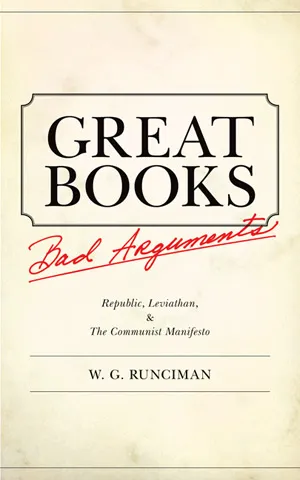
Great Books, Bad Arguments
W. G. Runciman Great Books, Bad Arguments: Republic, Leviathan, & The Communist Manifesto Princeton University Press138 pages, 8 x 5 inches ISBN 978 0691144764
Available here →June 21, 2010
20100621-runciman-garry-on-bad-arguments-republic-leviathan-communist-manif-3
A close-up
The rest of this thread
%2520Runciman.clean.webp)
W. G. (Garry) Runciman
W. G. (Garry) Runciman has been a Fellow of Trinity College, Cambridge since 1971. He holds honorary degrees from the Universities of Edinburgh, London, Oxford, and York. He is a Fellow of the British Academy and a Foreign Honorary Member of the American Academy of Arts and Sciences. Besides Great Books, Bad Arguments, featured in his Rorotoko interview, his other books include A Treatise on Social Theory, The Social Animal, and The Theory of Social and Cultural Selection.
Pull this thread
Plato, Hobbes and Marx endure because they make readers share their anger and hope, not their unconvincing arguments.
Know something the rest of us don't?
Most threads on Rorotoko begin with our invitation. Any thread can begin with a proposal: you write it with the same prompts every thread answers, and we review it.
Propose a thread →