
W. G. (Garry) Runciman
Great Books, Bad Arguments
That the concerns which Republic, Leviathan, and the Communist Manifesto address are of perennial importance is not in doubt. I first encountered the three books as a student more than fifty years ago, and it never crossed my mind to question why they were there on the reading lists.
But since then, I have pursued an academic career as a comparative and historical sociologist studying the range of political, ideological, and economic institutions which have evolved down the ages and across the world and the reasons for which they have or have not held together under different historical conditions. It is no surprise, therefore, that I should have reacted rather differently when reading the three books for the second time half a century later.
Sociology is not, and never will be, able to resolve Plato’s, Hobbes’s, and Marx’s concerns by laying down a political constitution which will guarantee internal peace. But over the last hundred years, the social sciences have made striking advances in our understanding of the institutional mechanisms and psychological dispositions which hold large societies of unrelated people together—despite the inherent conflicts of interest which always have, and always will, put different individuals and groups within their population into competition with one another for power.
It was that thought, and then a chance conversation with an eminent authority on Greek philosophy, which set me off to re-read first Republic, then Leviathan, and then The Communist Manifesto. This book is the result.
Editor: Erind Pajo
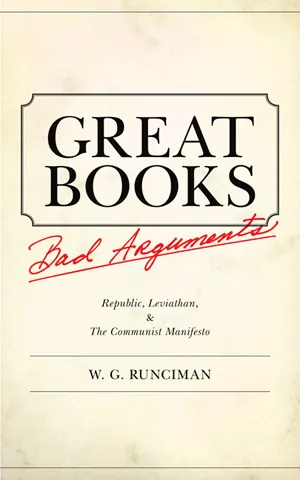
Great Books, Bad Arguments
W. G. Runciman Great Books, Bad Arguments: Republic, Leviathan, & The Communist Manifesto Princeton University Press 138 pages, 8 x 5 inches ISBN 978 0691144764
Available here →June 21, 2010
20100621-runciman-garry-on-bad-arguments-republic-leviathan-communist-manif-2
The wide angle
The rest of this thread

W. G. (Garry) Runciman
W. G. (Garry) Runciman has been a Fellow of Trinity College, Cambridge since 1971. He holds honorary degrees from the Universities of Edinburgh, London, Oxford, and York. He is a Fellow of the British Academy and a Foreign Honorary Member of the American Academy of Arts and Sciences. Besides Great Books, Bad Arguments, featured in his Rorotoko interview, his other books include A Treatise on Social Theory, The Social Animal, and The Theory of Social and Cultural Selection.
Pull this thread
pulls againstpulls alongside
Plato, Hobbes and Marx endure because they make readers share their anger and hope, not their unconvincing arguments.
Against SB · Where to draw the line between gambling and investment is a moral and political question, not a technical one. On: The past supplies usable guidance for present decisions
Against CK · Isolationism was the dominant American statecraft from the founding to Pearl Harbor, and it served the nation well. On: The past supplies usable guidance for present decisions
Alongside FB · Capitalism has outlived two centuries of predicted deaths because it is rooted in the hierarchical, individualistic structure of Western societies. On: The past supplies usable guidance for present decisions
Alongside JS · The judgment of history is a fantasy, and history renders no verdict at all, only a record of contention. On: The past supplies usable guidance for present decisions
Alongside DK · East Asia's four Sinicized states had five centuries of almost no war because the tribute system supplied the rules. On: The past supplies usable guidance for present decisions
Alongside AB · Asking what Jefferson or the founders would do is mostly an illegitimate question. On: The past supplies usable guidance for present decisions
Nearby PA · Conservatism has no fixed content, so the American Civil War was a fight between two conservatisms.
Know something the rest of us don't?
Most threads on Rorotoko begin with our invitation. Any thread can begin with a proposal: you write it with the same prompts every thread answers, and we review it.
Propose a thread →