
Bruce Thomas Boehrer
Animal Characters
One bit of Animal Characters should interest anyone who has ever wondered about the history of cats and their relationship with human beings. In it I unearth a centuries-long tradition of cat-torture, both on the European continent and in Britain, which evolved out of pagan worship to become part of Catholic calendar festivals and then, still later, of Protestant festivals as well.
The tale of this evolution is both fascinating and grisly, with cats publicly tortured on festival days in ways obscenely reminiscent of Christ’s passion. I trace the story of these animals’ maltreatment through literary works such as William Baldwin’s Beware the Cat (sometimes called the first English novel), the Cambridge University comedy Gammer Gurton’s Needle (the earliest surviving English play to bring a cat onstage), and works by Shakespeare, Cervantes, and others.
The cats I look at are tormented in endless ways, with whips and cudgels and firebrands and more, in fiction and drama and historical records over a span of many centuries. And always, so it seems, the violence occurs in a spiritual context. In pagan religious practice, cats are tortured to effect magic. In Catholicism the cat-torture is assimilated to church calendar festivals such as the feast of Saint John the Baptist. And when England goes Protestant, the cat-torture continues—now as an anti-Catholic insult.
As this story unfolds, the persecuted cats of early modern Europe come to seem more and more like doubles of the suffering Christ himself: the ritually tormented scapegoat on whose sacrifice the system of ritual itself depends.
Our treatment of nonhuman beings has grown into one of the more worrisome aspects of modern social practice, posing problems on the economic, ecological, dietary, and ethical levels. Destruction of habitat, species persecution, factory farming, zoo-keeping, animal experimentation, animal entertainment: these and related practices have grown markedly—some would say alarmingly—over the past five hundred years.
As a piece of literary and social history, Animal Characters supplies some of the back-story to these issues. One chapter traces the history of the turkey from its domestication by the Aztecs to its appearance on the tables of European diners. Another follows the transformation of the horse from a sentient instrument of warfare into an accouterment of elite sporting activities. Another describes the parrot’s evolution from menagerie marvel to annoying house-pet.
More generally, Animal Characters draws inspiration from the idea that our humanity is nowhere put more clearly on display, for better and for worse, than in our encounters with nonhuman life. To this extent, the book contributes to a broad and ongoing conversation about how we relate to the natural world and its other living creatures.
Editor: Erind Pajo
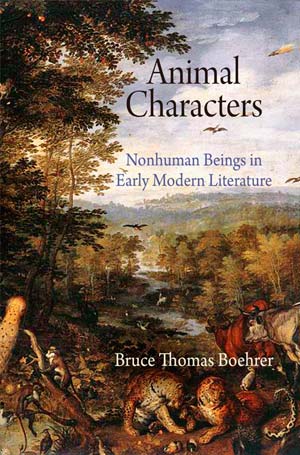
Animal Characters
Bruce Thomas Boehrer Animal Characters: Nonhuman Beings in Early Modern Literature University of Pennsylvania Press 256 pages ISBN 978 0812242492
Available here →June 28, 2010
20100628-boehrer-bruce-on-animal-character-nonhuman-being-modern-literature-3
A close-up
The rest of this thread
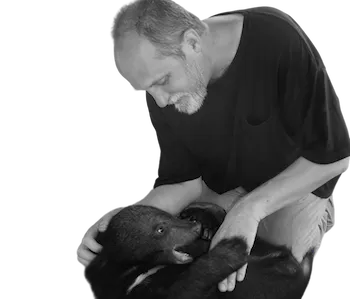
Bruce Thomas Boehrer
Bruce Boehrer is Bertram H. Davis Professor of English and 2009-11 Frances Cushing Ervin Professor of English at Florida State University. Besides Animal Characters, featured in his Rorotoko interview, he is also the author of four other books, including Shakespeare among the Animals (Palgrave, 2002) and Parrot Culture (Penn, 2004), and editor of A Cultural History of Animals in the Renaissance (Berg, 2007). From 1999 to 2008 he served as founding Editor and later Co-Editor of the Journal for Early Modern Cultural Studies. He lives in Florida with his wife, the environmental artist Linda Hall.
Pull this thread
Once Descartes made consciousness uniquely human, literature dropped sentient beasts and built the novel to display human subjectivity.
Know something the rest of us don't?
Most threads on Rorotoko begin with our invitation. Any thread can begin with a proposal: you write it with the same prompts every thread answers, and we review it.
Propose a thread →