
Andrew Herscher
Violence Taking Place
Trained as an architect and an architectural historian, I was led to re-think destruction when I began to survey its remains in Kosovo for the International Criminal Tribunal for the Former Yugoslavia.
For the Tribunal, as for most of destruction’s interpreters, destruction comprised a representation of something else, something that occupied a different level of value, significance and conceptual coherence. For the Tribunal, destruction represented the actions of the alleged perpetrator on trial. For scholarly disciplines, destruction represents the social, political, cultural or ideological dynamic that the discipline in question knows how to study.
Coming to destruction as a historian of architecture, however, I was struck with it as a form of architecture, a kind of architecture-in-reverse, and so possible or even necessary to understand via the particular interpretive protocols of architecture.
Most important to me is the imperative to acknowledge architecture as irreducible to its various contexts—as emerging from but also somehow different than those contexts, as in some ways specific, particular and distinctive in itself. This acknowledgement leads to an understanding of destruction as, like architecture, a form of cultural production, formative of the identities, agencies and contexts that seemingly bear on it as causes. I argue, then, that destruction should not be approached as a mere surface expression of supposedly deeper contexts and that its analysis shouldn’t rest on mere “contextualization.” Destruction instead ought to be subject to critical interpretation, I suggest, just like architecture and any other cultural form.
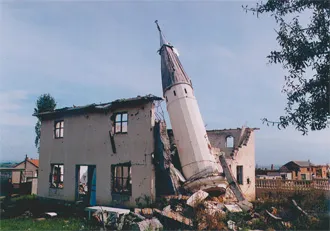
Mosque in Reti e Poshtme, Kosovo, dynamited in March 1999. Photograph by Andrew Herscher.
Editor: Erind Pajo
Violence Taking Place
Andrew Herscher Violence Taking Place: The Architecture of the Kosovo Conflict Stanford University Press 224 pages, 9 x 6 inches ISBN 978 0804769365
Available here →August 2, 2010
20100802-herscher-andrew-violence-taking-place-architecture-kosovo-conflict-2
The wide angle
The rest of this thread

Andrew Herscher
Andrew Herscher is an Assistant Professor of Architecture at the University of Michigan. He surveyed wartime destruction in Kosovo for the International Criminal Tribunal for the Former Yugoslavia, worked as a cultural heritage officer for the United Nations Mission in Kosovo, and co-founded the non-governmental organization Kosovo Cultural Heritage Project. He has also published in such journals as Assemblage, Future Anterior, Grey Room, Harvard Design Review, Journal of the Society of Architectural Historians, Oxford Art Journal, and Theory and Event. He is currently working on two projects: the politics of historic preservation in post-Yugoslavia and the architecture of post-conflict reconstruction.
Pull this thread
Architecture is destroyed in order to make it stand for something in the first place.
Know something the rest of us don't?
Most threads on Rorotoko begin with our invitation. Any thread can begin with a proposal: you write it with the same prompts every thread answers, and we review it.
Propose a thread →