
Andrew Herscher
Violence Taking Place
Much of Violence Taking Place appears to be dedicated to violence “over there,” apparently far away—politically if not geographically—from most readers in the Global North.
But in one section of the book, a supplement on NATO’s 1999 air war against Serbia, I suggest that architecture functioned in that war in just the same way as it functioned on the ground in Kosovo—as a way to make manifest otherwise inchoate or invisible presences. For NATO, those presences were the Serbian “war machine,” “command-and-control system,” “military network,” and “infrastructure”—the explicit targets of NATO’s violence. Yet those targets were made available to NATO and subject to destruction by representing them architecturally, as the different sorts of buildings which came to be included in NATO’s every-expanding “target set.”
At the same time, the representation of targets as architecture and not as human beings allowed NATO to leave the human targets of its bombing campaign—both members of Serbian armed forces and civilians alike—unrepresented. NATO represented its war by images like videos shot by cameras mounted on precision-guided weapons or by surveillance photographs that showed buildings before and after they were attacked.
But these images displaced other images and even knowledge of other destruction, inflicted on human beings whose injury or death was only noted as “collateral damage.” Human bodies were often violated in the course of violating buildings; in these cases, then, the videos shot by precision-guided weaponry were snuff films screened as architectural studies.NATO’s air war was imagined and narrated as a “humanitarian war,” conducted in the name of human rights (those of the Kosovar Albanians besieged in the violent Serbian counter-insurgency) by the seemingly humanitarian means of precision-guided weaponry.
The humanitarian nature of the war, however, was a fully architectural production, represented by architecture that seemingly allowed the targets of the war to be attacked and that allowed the human victims of that war to be left invisible.
We’re surrounded by the images and remains of destruction—from the targets of so-called “terrorism” to those of technologically-sophisticated warfare. This material suggests that architecture is no longer what it once was, or at least what it was once said to be—in Walter Benjamin’s famous words, “the prototype of a work of art the reception of which is consummated by a collectivity in a state of distraction.”
Indeed, the intensively visualized NATO air war marked a key moment in the formation of architecture as a privileged mediation of violence and thus, into an object of scrutiny for a public guided by military image capture and aesthetics. In times and places of emergency, in other words, architecture is no longer the object of a distracted perception, but rather a perception that tracks violence, whether with fear, regret, satisfaction, confusion or unease.
During and since the NATO air war, then, a militarized public attention has been fixed on architecture, on buildings whose destruction is threatened, imminent, in process, complete, or anticipated. These buildings are not only destroyed by violence; they also comprise decoys, lures or ruses, substituting for or repressing other sites and sights of violence. There’s no time like the present, then, to scrutinize destruction more closely.
Violence Taking Place tries to suggest how this scrutiny might proceed and, in so doing, reframe our understanding of the violence that destruction often mediates.
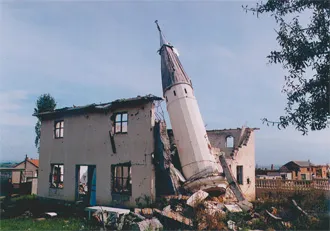
Mosque in Reti e Poshtme, Kosovo, dynamited in March 1999. Photograph by Andrew Herscher.
Editor: Erind Pajo
Violence Taking Place
Andrew Herscher Violence Taking Place: The Architecture of the Kosovo Conflict Stanford University Press 224 pages, 9 x 6 inches ISBN 978 0804769365
Available here →August 2, 2010
20100802-herscher-andrew-violence-taking-place-architecture-kosovo-conflict-3
A close-up
The rest of this thread

Andrew Herscher
Andrew Herscher is an Assistant Professor of Architecture at the University of Michigan. He surveyed wartime destruction in Kosovo for the International Criminal Tribunal for the Former Yugoslavia, worked as a cultural heritage officer for the United Nations Mission in Kosovo, and co-founded the non-governmental organization Kosovo Cultural Heritage Project. He has also published in such journals as Assemblage, Future Anterior, Grey Room, Harvard Design Review, Journal of the Society of Architectural Historians, Oxford Art Journal, and Theory and Event. He is currently working on two projects: the politics of historic preservation in post-Yugoslavia and the architecture of post-conflict reconstruction.
Pull this thread
Architecture is destroyed in order to make it stand for something in the first place.
Know something the rest of us don't?
Most threads on Rorotoko begin with our invitation. Any thread can begin with a proposal: you write it with the same prompts every thread answers, and we review it.
Propose a thread →