
Tony Whyton
Jazz Icons
In my view, the most thought provoking (and potentially provocative) section of the book links to the way in which jazz history promotes masculine and heterosexual norms.In my opening chapter, I examine the way in which jazz can be understood as a heterosexual masculine discourse, from the way the history of ‘great men’ blends narrative influences from the 19th century genius to the American cowboy. Even at the level of language, jazz is governed by masculine rhetoric; tenor ‘titans’, saxophone ‘colossuses’ and musicians that engage in cutting contests, trade punches and blow each other off the bandstand.Masculine and heterosexual norms are later explored in a chapter on the life and music of Duke Ellington. Several years ago, the author David Hajdu published an article in Vanity Fair that gave a beautiful account of the relationship between Duke Ellington and Billy Strayhorn and posed the question of whether their friendship could have gone beyond the purely professional.From my perspective, it is irrelevant and impossible to know whether Ellington was in fact bisexual. However, what I am interested in is the problem this concept presents for jazz audiences and fans of Ellington alike. Within the chapter, I trace several narrative themes that are used to encapsulate the spirit of Ellington and his music but then question the extent to which these themes have anything to do with Ellington’s actual life experience.The ‘problem’ of an artistic jazz legend being bisexual tells us something about the way in which great artists have to adhere to certain stereotypical traits in order to remain authentic. And it makes us think both about how music itself is sexualised and about broader societal views.Although gender and sexuality are only aspects of a much broader discussion of iconic influence in jazz within the book, these examples demonstrate very clearly the way in which jazz history is controlled ideologically to perpetuate and reinforce certain values and beliefs.Jazz Icons runs contrary to the dominant offerings of jazz history. The book is an alternative take on jazz historiography, providing the readers with a close examination of the changing role of musicians in history.Besides turning everyday assumptions on their heads, Jazz Icons finds significance in things that usually go unnoticed.This approach encourages the reader to see the world critically and to question the notion that music just exists naturally or that history is an unchanging, linear and unified story.
Editor: Erind Pajo
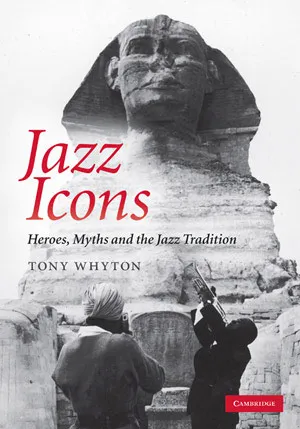
Jazz Icons
Tony Whyton Jazz Icons: Heroes, Myths and the Jazz Tradition Cambridge University Press230 pages, 10 x 7 inches ISBN 978 0521896450
Available here →August 9, 2010
20100809-whyton-tony-on-jazz-icons-heroes-myths-jazz-tradition-3
A close-up
The rest of this thread

Jason Broadhurst
Tony Whyton
Tony Whyton is co-editor of the internationally peer-reviewed Jazz Research Journal and is currently working on his second book, Beyond A Love Supreme, a cross-disciplinary study of the musical and cultural influence of John Coltrane’s seminal album. A leading figure in international jazz research, he established the Centre for Jazz Studies UK, and is currently the Project Leader for the €1 million European research programme Rhythm Changes: Jazz Cultures and European Identities, funded as part of the HERA Joint Research Programme. Tony is a Reader in Music at the University of Salford.
Pull this thread
Jazz history, told as a succession of God-like male heroes, enforces masculine and heterosexual norms.
Know something the rest of us don't?
Most threads on Rorotoko begin with our invitation. Any thread can begin with a proposal: you write it with the same prompts every thread answers, and we review it.
Propose a thread →