
Edward B. Barbier
A Global Green New Deal
Many observers of economic policy enacted during the 2008-9 recession will have noted that some governments included many investments in energy efficiency, clean energy, waste management and other environmental improvements as part of their fiscal stimulus efforts. Some people would argue that such measures, popularly referred to as “green stimulus,” were an important step in initiating a global green recovery.
Unfortunately, such a perception is misleading—the book’s Chapter 1 explains.
It is true that a unique feature of the global policy response to the 2008-9 recession is that, as part of their efforts to boost aggregate demand and growth, some governments adopted expansionary policies that also incorporated a sizable “green fiscal” component. South Korea and China devoted large chunks of their financial stimuli to green projects. The US included a sizable green fiscal component as well. By July 2009, over $460 billion had been spent globally by governments on green measures, and currently, the total is over $520 billion.
Although the total amount spent on green stimulus seems impressive, and is a promising start towards a GGND, it is not sufficient to launch a global green recovery.
First, only a handful of economies—almost exclusively members of the G20—devoted a significant chunk of their total fiscal spending to green stimulus; most were cautious about making low-carbon and other environmental investments during a recession, and some did not implement any green stimulus measures at all.
Second, fossil fuel subsidies and other market distortions, as well as the lack of effective environmental pricing policies and regulations, will diminish the impacts of G20 green stimulus investments on long-term investment and job creation in green sectors. Without correcting existing market and policy distortions that under-price the use of natural resources, contribute to environmental degradation, and worsen carbon dependency, public investments to stimulate clean energy and other green sectors in the economy will be short lived. The failure to implement and coordinate green stimulus measures across all G20 economies also limits their effectiveness in “greening” the global economy.
Finally, the G20 has devoted less effort to assisting developing economies that have faced worsening poverty and environmental degradation as a result of the global recession. Nor has the G20 taken a leadership role in facilitating negotiations towards a new global climate change agreement to replace the Kyoto Treaty that will expire in 2012.
As argued in Chapter 11, by failing to adopt a comprehensive GGND strategy the G20 and the world economy is also missing the opportunity to address global structural imbalances and chronic debt. A global green recovery strategy of reducing carbon dependency and improving energy security may help to control both the large current account deficits incurred by major oil-importing economies, such as the United States, and to reduce the trade surpluses of fossil fuel exporting economies. Increased clean energy investments from domestic and overseas sources of financing would also reduce the “savings glut” of Asian and other emerging market economies, and help them shift from labor-intensive export goods to skill, capital and technology-intensive production.
Overall, this book is the culmination of over twenty-five years of thinking about “greening” modern economies. And the subtitle, Rethinking the Economic Recovery, is in some respects its most important message.
In 1989, along with David Pearce and Anil Markandya, I authored Blueprint for a Green Economy, which presented, for the first time, practical policy measures for “greening” modern economies and putting them on a path to sustainable development.
Since then, some of these policy measures have been implemented. Most have been ignored, however. But a Global Green New Deal may be our last opportunity to put the world economy on a truly sustainable path.
What is urgently required is a new economic development model based on reducing environmental harm and scarcities, improving the livelihoods of the world’s poorest, training workers for twenty-first century skills and employment opportunities, and reducing the carbon dependency of the global economy. The book demonstrates that there is not necessarily a tradeoff between policies to improve the environment and instigating a successful and lasting world economic recovery. To the contrary, it is necessary to reduce carbon dependency and ecological threats not just because of environmental concerns but because this is the correct—and only—way to reinvigorate the economy on a more sustained basis.
It is still not too late for the G20 and the international community to rethink the economic recovery, to enhance global climate change initiatives and negotiations, improve energy security, phase out fossil fuel subsidies, and reduce the economic vulnerability of the world's poor. But we may not have another twenty-five years to wait.
Editor: Erind Pajo
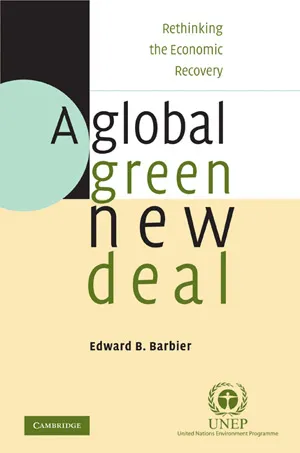
A Global Green New Deal
Edward B. Barbier A Global Green New Deal: Rethinking the Economic Recovery Cambridge University Press 322 pages, 9 x 6 inches ISBN 978 0521132022 ISBN 978 0521763097
Available here →September 6, 2010
20100906-edward-barbier-global-green-new-deal-rethinking-economic-recovery-3
A close-up
The rest of this thread

Edward B. Barbier
Edward B. Barbier is the John S Bugas Professor of Economics at the University of Wyoming. He has worked for over 25 years at the interface between economics and ecology, and served as a consultant and policy analyst for a variety of national, international and non-governmental agencies, including many UN organizations and the World Bank. Professor Barbier has authored over 150 peer-reviewed articles and chapters, is on the editorial boards of several leading economics and natural science journals, and appears in the 4th edition of Who’s Who in Economics. Among the nineteen books he has written or edited are Blueprint for a Green Economy (with David Pearce and Anil Markandya, 1989), Natural Resources and Economic Development (2005), and A Global Green New Deal (2010), featured in his Rorotoko interview.
Pull this thread
There is no tradeoff between reviving the world economy and greening it.
Know something the rest of us don't?
Most threads on Rorotoko begin with our invitation. Any thread can begin with a proposal: you write it with the same prompts every thread answers, and we review it.
Propose a thread →