
Lynn M. Morgan
Icons of Life
Icons of Life explains how we came to think of embryos as tiny, unborn versions of our selves.
Today embryos and fetuses are veritable little persons; they star in their own videos, are featured in magazines, provide employment, and prompt legislation. How did they become such animated, lifelike, volitional little things?
There was a time, not long ago, when even well-educated adults would hardly have been able to imagine what a human embryo looked like. And they certainly did not grant embryos or fetuses much moral or political status.
In this book, I argue that our embryological world view is not based simply on an accumulation of facts, but on a rendition of those facts that portrays embryos as independent entities—and that masks the way in which fetal images are produced.
Icons of Life describes a little-known embryo collecting project funded by the Carnegie Institution of Washington in 1913.
Anatomists based at Johns Hopkins began to collect embryos and to encourage their colleagues to save the contents of the uterus when their pregnant patients miscarried, aborted, or died. Early pregnancy testing did not yet exist, so some of the youngest specimens in the collection came from elective hysterectomies deliberately timed to coincide with the earliest stages of an undiagnosed pregnancy.
By 1944, the Carnegie Human Embryo Collection had grown to nearly 10,000 specimens. Scientists’ descriptions of those specimens shaped much of what we now know about embryological development.
Ironically, those specimens came to symbolize the beginnings of human life. Yet even many of today’s iconic images of embryonic and fetal “life” actually depict dead specimens.
Meanwhile, until now, the strange story of human embryo collecting has remained largely hidden.
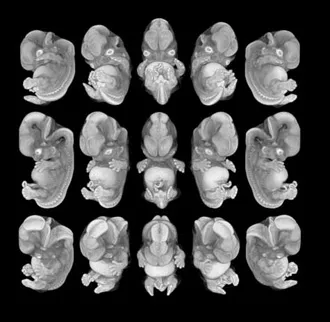
Magnetic resonance image of a 50-day human embryo. (Courtesy of Bradley R. Smith, School of Art and Design, University of Michigan.)
Editor: Erind Pajo
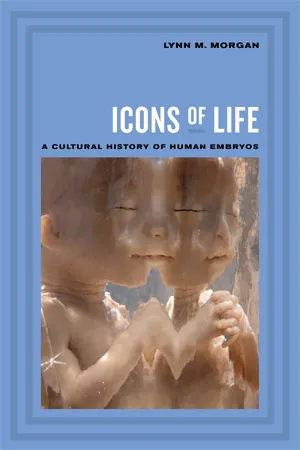
Icons of Life
Lynn M. Morgan Icons of Life: A Cultural History of Human Embryos University of California Press 328 pages, 9 x 6 inches ISBN 978 0520260443 ISBN 978 0520260436
Available here →October 6, 2010
20101006-morgan-lynn-on-icons-of-life-cultural-history-human-embryos-1-1
In a nutshell
The rest of this thread

Noah Morgan-Trostle
Lynn M. Morgan
Lynn M. Morgan is a medical anthropologist and Mary E. Woolley Professor of Anthropology at Mount Holyoke College. In addition to Icons of Life, featured in her Rorotoko interview, she is author of Community Participation in Health: The Politics of Primary Care in Costa Rica (Cambridge, 1993) and numerous articles about reproductive ideologies and fetal politics, as well as co-editor of Fetal Subjects, Feminist Positions (University of Pennsylvania Press, 1999). Her work has been supported by the National Science Foundation, National Endowment for the Humanities, Fulbright-Hays, Social Science Research Council, and the School for Advanced Research. She is currently writing about reproductive governance in Mexico and Central America.
Pull this thread
The autonomous, person-like embryo was manufactured by Carnegie's specimen collectors, who made the pregnant women invisible.
Know something the rest of us don't?
Most threads on Rorotoko begin with our invitation. Any thread can begin with a proposal: you write it with the same prompts every thread answers, and we review it.
Propose a thread →