
George R. Packard
Edwin O. Reischauer and the American Discovery of Japan
I found Reischauer’s life to be profoundly interesting, and perhaps even tragic, as a human interest story. His younger sister, Felicia, was born deaf and mute, and Ed had to help take care of her for the rest of his life. His older brother, Robert, also a brilliant scholar, was killed by a stray Chinese bomb in Shanghai in 1937.
His missionary parents were forced to abandon their life’s work in Japan with the outbreak of war between the two nations they loved.Reischauer married Adrienne, the love of his life, and a fellow Oberlin graduate, while they were both graduate students. They had three children. Adrienne developed a heart condition at age 39 that crippled her for an agonizing five years before her death in 1955. Reischauer, at 45, was left to bring up three teenagers.
As Ambassador, Reischauer was the victim of a bizarre knife attack at the entrance to the embassy by a deranged Japanese youth. Japan’s best American friend nearly bled to death, and then was given massive blood transfusions that infected him with hepatitis C. This virus gradually destroyed his liver and ultimately killed him at the age of 79.In the 1970’s, he was harshly denounced by some of his own students for his defense as Ambassador to Japan of the war in Vietnam (even though he had personally opposed the war).
Finally, he was criticized for being too “soft on Japan” during the trade frictions of the 1980’s. Ed Reischauer died fearing his life’s work had been a failure. Yet he never felt sorry for himself, never abandoned his faith in the Japanese people. And in the end, I argue, he was vindicated in that faith.
There are eerie similarities between our attitudes toward Japan in the 1980’s and our attitudes toward China today. The Chinese are heirs to a proud civilization that has been humiliated by the West for the last two centuries, and are now recovering their traditional role as the leading power (“central kingdom”) in East Asia. They are rapidly building up their military, and aggressively exporting products to our market at artificially low exchange rates.
Fortunately, we have learned some lessons from our dealings with Japan in the 1980’s. In the tradition of President Kennedy’s appointment of Reischauer as his ambassador to Tokyo, President Obama has wisely chosen Jon Huntsman, who speaks and understands Chinese, to be his ambassador to Beijing.
Still, we have inherited a role in the Chinese civil war through our support of Taiwan. And some elements in the US military seem to think that the Western Pacific is and should be “an American lake.”
Containing China is no longer an option. Finding ways to bring it peacefully into the international system is our best option. In our policies toward China, we and the Japanese are not playing a zero sum game; both of us need to do everything possible to make that happen. If Reischauer were alive today, he would advocate taking immediate steps to curb the current arms race with China, launch a massive program to educate a new generation of Chinese and American students about each other and our different histories and cultures, and schedule regular meetings at the highest levels between Chinese and American officials to sort out the issues that divide us.Reischauer would find and proclaim “absurd” the journalists who predict an inevitable “clash for supremacy” in the Pacific.
Editor: Erind Pajo
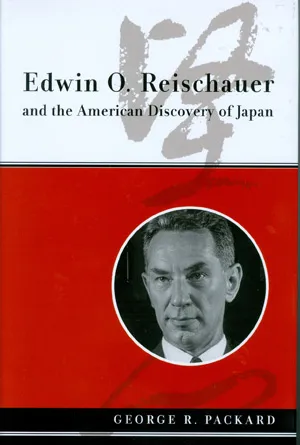
Edwin O. Reischauer and the American Discovery of Japan
George R. Packard Edwin O. Reischauer and the American Discovery of Japan Columbia University Press368 pages, 9 1/4 x 6 inches ISBN 978 0231143547
Available here →October 13, 2010
20101013-george-packard-on-edwin-o-reischauer-american-discovery-japan-3
A close-up
The rest of this thread

Michael Dames
George R. Packard
George R. Packard has been President of the United States-Japan Foundation since 1998. He is also Adjunct Professor of Political Science at Columbia University, and Chairman of the Advisory Board at the Weatherhead East Asian Institute there. Dr. Packard was Dean of the Johns Hopkins School of Advanced International Studies from 1979 to 1993, and Visiting President of the International University of Japan from 1994 to 1998. Earlier in his career, Dr. Packard was an intelligence officer and later a special assistant to US Ambassador Edwin O. Reischauer in Tokyo. He is the author of eight books, and of articles that have appeared in the New York Times, Washington Post, Foreign Affairs, and elsewhere. Dr. Packard received from the Japanese Government the Order of the Rising Sun, Gold and Silver Stars in November 2007. He studied at Princeton University (B.A.) and at Tufts’ Fletcher School of Law and Diplomacy (M.A. and Ph.D.).
Pull this thread
Reischauer got Japan right, and deep language and area knowledge inside government prevents wars.
Know something the rest of us don't?
Most threads on Rorotoko begin with our invitation. Any thread can begin with a proposal: you write it with the same prompts every thread answers, and we review it.
Propose a thread →