
Lynn Stout
Cultivating Conscience
On a warm summer evening in Los Angeles, Franco Gonzales, an undocumented immigrant working as a dishwasher in a Chinese restaurant, was waiting alone at a bus stop. An armored car drove by. It rear doors mysteriously swung open, dropping a plastic bag that contained $203,000 in cash at Gonzales’ feet. Gonzales took the money home. After a long night spent wrestling with his conscience, he called the police to return the money to its anonymous owner. Gonzales’ story was unusual enough to be reported in the national press. (It isn’t every day a small fortune lands at someone’s feet.)
But the remarkable tale of the honest dishwasher is not really that remarkable.Civic life in the Unites States is filled with similar, if more modest, acts of decency and forbearance. Beefy young men wait patiently behind frail senior citizens instead of pushing to the front of the line. Drivers wait for red light to turn green, even when the police are out of sight. People withdraw cash from ATM machines without bothering to carry weapons or hire armed guards.
Kidnapping for ransom is rare and unusual.Indeed, conscientious behavior is so deeply woven into the warp and woof of American life that it usually goes unnoticed. We take for granted the innumerable small, unselfish acts that bind us together in a civil society, just as we take for granted the gravitational force that keeps us from floating out into space.
But sometimes gravity produces results dramatic enough to make us ponder: when an apple fell on Isaac Newton’s head, he stopped to think. When a dishwasher goes out of his way to return $203,000 in cash to its anonymous owner, we should also stop to think. What’s going on here, and how can we get more of it?We ignore the force of conscience at our peril. The scientific evidence demonstrates that we can craft better laws and rules by employing critical social cues to encourage more unselfish, ethical behavior in many realms—including politics and business.
By the same token, we can also encourage selfishness, opportunism, and illegality.I wrote this book to show how our current emphasis on self-interest and material incentives may have contributed to the catastrophic political missteps and financial scandals of recent memory by encouraging corrupt and selfish actions, and by undermining society's collective moral compass. If we care about effective laws and civilized society, the powers of conscience are simply too important for us to ignore.
Editor: Erind Pajo
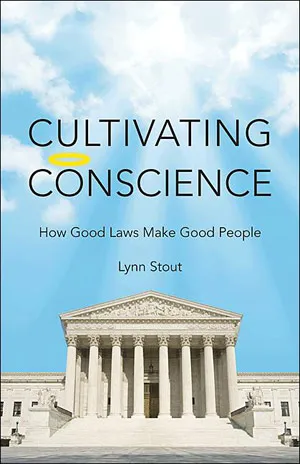
Cultivating Conscience
Lynn Stout Cultivating Conscience: How Good Laws Make Good People Princeton University Press 296 pages, 5 1/2 x 8 1/2 inches ISBN 978 0691139951
Available here →November 17, 2010
20101117-stout-lynn-on-cultivating-conscience-how-good-law-make-good-people-3
A close-up
The rest of this thread

Lynn Stout
Lynn Stout is the Paul Hastings Professor of Corporate and Securities Law at the University of California, Los Angeles School of Law. An internationally recognized expert in the fields of corporate governance, law and economics, and moral behavior, she lectures widely and has authored numerous articles and books on these topics. Lynn Stout is a frequent commentator for the Wall Street Journal, the New York Times, the PBS Newshour and National Public Radio. She received her education from Princeton University and Yale Law School.
Pull this thread
pulls againstpulls alongside
Unselfish behavior is common and switched on by social cues, so law should trigger conscience rather than price conduct.
Against JS · The prohibition on hosting kleptocrats' money fails for structural reasons, and the remedy is to recruit the profit motive. On: Human conduct is well modelled as self-interested calculation of costs and benefits
Against EP · States punish violators of international law badly, so they violate it with impunity when benefits exceed costs. On: Human conduct is well modelled as self-interested calculation of costs and benefits
Alongside PG · Modern money is bank credit, therefore debt, and debt has replaced God as the guarantee of human cooperation. On: Human conduct is well modelled as self-interested calculation of costs and benefits
Alongside AS · A social worker's finding of neglect is as factual as a doctor's reading of a blood-pressure number. On: Human conduct is well modelled as self-interested calculation of costs and benefits
Alongside NE · People consistently underestimate how positively others will respond to being engaged, and the result is chronic undersociality. On: Human conduct is well modelled as self-interested calculation of costs and benefits
Alongside CP · The unhoused on our streets are ourselves dressed in rags, and refusing them empathy costs us dearly. On: Human conduct is well modelled as self-interested calculation of costs and benefits
Nearby RJ · Forty years of deregulation, not excessive regulation, shrank the public markets and delayed IPOs.
Know something the rest of us don't?
Most threads on Rorotoko begin with our invitation. Any thread can begin with a proposal: you write it with the same prompts every thread answers, and we review it.
Propose a thread →