
Paula Lupkin
Manhood Factories
The American Young Men’s Christian Association, which began as a Protestant evangelical voluntary association in the 1850s, built hundreds of buildings in the years between the Civil War and the Great Depression. These YMCA buildings were more than a place for young men to play; they were a successful attempt to infuse traditional Protestant values of hard work and self-restraint into an environment that was increasingly defined by an ethic of consumption and the rise of corporate culture.
Y buildings were our first community centers. Before the YMCA started to construct clubhouses, there were few respectable public places to spend the increasingly structured “leisure” time available to urbanites. This religious group legitimized and rationalized leisure, providing an alternative to the saloon and the theater that was to influence dozens of other private and public agencies, including the YWCA, the settlement houses, and municipal reform groups.
The processes by which YMCA buildings were made and used articulated complex ideas about religion, gender, race, and class. Manhood Factories traces the evolution of Y buildings from “Christian clubhouse” in the 1870s to hotel and community center in the 1920s, focusing on fundraising, design, construction, programming, marketing, and use. These activities shaped not only the lives of YMCA members, but also the larger public culture and public space of the modern American city.
Manhood Factories is the first book to take YMCA architecture as its subject and its scope is large. This is not the story of a few key buildings, but an account of a national and even international movement.
It was in many ways the size of the enterprise that attracted me to the project. Why, and how, did the YMCA build so much? How did the YMCA become a building? And why did they all look alike?
Traditionally, scholars of the built environment have enforced a strict hierarchy of high and low.
In architectural history, the field in which I was trained, the subjects of study are exemplary, even extraordinary buildings designed by famous architects. There are a few Y buildings designed by big names, but I was interested in the phenomenon as a whole, rather than the greatest hits. Vernacular architecture studies focus on common buildings with no named designer, but typically these are rural barns and houses. Manhood Factories addresses the space in between; what I call the middle ground.
Neither high nor low, the middle ground is the common landscape of American cities. Middle ground buildings are usually designed by architects, but they aren’t famous ones.
The appearance of middle ground buildings isn’t distinctive; in fact it is often standardized and indistinguishable from one example to the next. They are often seen as the background to the great monuments that have been the object of study.
Manhood Factories was my opportunity to put buildings like the YMCA, present in every town in nearly identical form, in the foreground. Following in the path of vernacular architecture studies, my claim is that every YMCA building in every town is interesting and can tell us something about the people that made and used it.
The story of the Y suggests that the history of architecture is more broadly significant if we study the warp and the weft, the big monuments and small buildings together, as the urban fabric of the city.
Focusing on the processes that, in the words of sociologist Henri Lefebvre, produce space, my “middle ground” approach to the study of YMCA buildings addresses traditional art historical issues of style and precedent, but also places tremendous importance on the social, economic, political, and religious systems that gave rise to a national building movement.
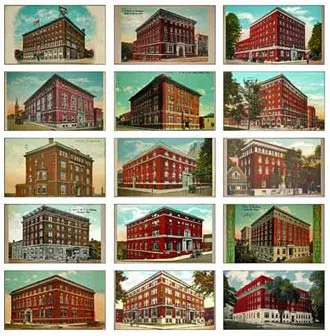
A selection of postcards from the Cliff Smith YMCA Postcard Collection depicting buildings designed by specialist architects Shattuck and Hussey, 1904-1916.
Editor: Erind Pajo

Manhood Factories
Paula Lupkin Manhood Factories: YMCA Architecture and the Making of Modern Urban Culture University of Minnesota Press 312 pages, 10 3/4 x 8 1/2 inches ISBN 978 0816648351 ISBN 978 0816648344
Available here →November 22, 2010
20101122-lupkin-paula-on-manhood-factories-ymca-architecture-modern-urban-2
The wide angle
The rest of this thread

Paula Lupkin
Paula Lupkin is a cultural and architectural historian with a special interest in the growth and development of American cities. She teaches in the American Culture Studies program at Washington University in St. Louis. Manhood Factories (Minnesota, 2010), featured in her Rorotoko interview, was supported with grants from the University of Pennsylvania, the Graham Foundation for Advanced Study in the Fine Arts, and the Charles Warren Center at Harvard University. This spring she will be a Quadrant Fellow at the Institute for Advanced Study at the University of Minnesota, working on a next book project about the connections between German beer and the American built environment.
Pull this thread
Modern American urban culture was made in ordinary buildings like the YMCA, not in monuments.
Know something the rest of us don't?
Most threads on Rorotoko begin with our invitation. Any thread can begin with a proposal: you write it with the same prompts every thread answers, and we review it.
Propose a thread →