
Paula Lupkin
Manhood Factories
One of the most intriguing visual elements of Manhood Factories is the extensive reproduction of postcards from the more than 10,000 items preserved in the Cliff Smith YMCA Postcard Collection at Springfield College.
Postcards are perhaps the richest source I encountered in my research because they offer so many layers of information. From a purely documentary standpoint, they serve as record of the appearance of Y buildings. Too often these buildings have been demolished and postcards are a quick and accessible snapshot of a building’s form and immediate context. Taken together, they provide a catalog of YMCA buildings that is unmatched in its completeness.
The importance of these postcards, however, goes far beyond simple documentation. Placed side by side, as they are arranged in the book, the postcards highlight the impact of standardization on the organization’s architectural identity. Seeing building after building in the same size and same style really drives home the idea of the YMCA as a building “type” that helped to define Main Street America.
First introduced in the late nineteenth century and legalized by the postal service in 1901, correspondence cards with images printed on one side were a national craze in the first two decades of the twentieth century. They were a quick, cheap, and easy way to communicate in an age of fast mail service and still incomplete telephone systems. Billions were sold each year, and special postcard shops opened to meet demand.
These little 3 x 5 cards, with image on one side, and often, with writing, dates, and addresses on the other, also have value as a source of information about the diffusion and reception of the YMCA building across the United States. They are really unparalleled sources in their capacity to reveal how people learned about the YMCA, and how they understood its buildings.YMCAs and local boosters printed cards as a symbol of pride, and they were sent all around the country as proof of the community’s progressive and moral character. Pen pals exchanged views of YMCA buildings in their cities, traveling salesmen and young men sent home reassuring cards from the YMCA to their wives and mothers, who collected them into albums or displayed them on the mantelpiece. The choice of a YMCA card had particular meaning for these correspondents, a fact made clear in many of the messages that were written on the verso side.
In this study, which is heavily drawn from materials published by the YMCA itself, the exchange of postcards offered refreshing and necessary insight into the popular reception of the YMCA. It helped to explain how and why the idea of the YMCA building, invented by New Yorkers, found traction and acceptance throughout the rest of the country. New technologies, like cheap color printing and railroad mail service, made it possible for everyday people to learn about the YMCA, to interpret it to their friends, and, through comparison to other cities, to come to understand the role of its buildings in the modern development of their hometown. Through the collection and distribution of postcards ordinary people gained agency in making these buildings meaningful, and I was thrilled to be able to include them in the book.
Manhood Factories is not simply a study of the place where young men played basketball. I wanted to account for how Americans negotiated the social, economic, and spatial transformations modernity wrought upon the American city.
The book contributes to gender studies by providing a badly-needed history of masculine space. It also sheds light on the role of religion in the rise of corporate culture, east-west technology transfer in the early twentieth century, the cultural dynamic between metropolitan and provincial centers in Gilded Age America, and the rationalization of leisure in the age of efficiency and productivity.
Most of all the book demonstrates the importance of the built environment in our broader understanding of American history. Usually relegated to a relatively obscure position as a subfield of art history, the history of building, and buildings, has broader significance.
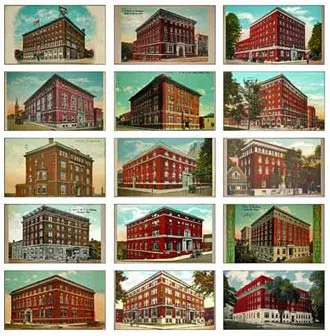
A selection of postcards from the Cliff Smith YMCA Postcard Collection depicting buildings designed by specialist architects Shattuck and Hussey, 1904-1916.
Editor: Erind Pajo

Manhood Factories
Paula Lupkin Manhood Factories: YMCA Architecture and the Making of Modern Urban Culture University of Minnesota Press 312 pages, 10 3/4 x 8 1/2 inches ISBN 978 0816648351 ISBN 978 0816648344
Available here →November 22, 2010
20101122-lupkin-paula-on-manhood-factories-ymca-architecture-modern-urban-3
A close-up
The rest of this thread

Paula Lupkin
Paula Lupkin is a cultural and architectural historian with a special interest in the growth and development of American cities. She teaches in the American Culture Studies program at Washington University in St. Louis. Manhood Factories (Minnesota, 2010), featured in her Rorotoko interview, was supported with grants from the University of Pennsylvania, the Graham Foundation for Advanced Study in the Fine Arts, and the Charles Warren Center at Harvard University. This spring she will be a Quadrant Fellow at the Institute for Advanced Study at the University of Minnesota, working on a next book project about the connections between German beer and the American built environment.
Pull this thread
Modern American urban culture was made in the YMCA's hundreds of near-identical, undistinguished buildings.
Know something the rest of us don't?
Most threads on Rorotoko begin with our invitation. Any thread can begin with a proposal: you write it with the same prompts every thread answers, and we review it.
Propose a thread →