
E. Taylor Atkins
Primitive Selves
Primitive Selves offers a different take on the history of Japanese colonial rule in Korea. Whereas most studies focus on specific policies—such as economic exploitation, compulsory education, assimilation directives, military mobilization, mechanisms of social control, and suppression of nationalist resistance—designed to erase indicators of an independent Korean national identity, this book examines this imperial relationship from the perspective of culture.
I argue that, alongside the brutality of Japanese colonialism in Korea, there was a parallel—if contradictory—impulse to document, preserve, and exhibit selected aspects of Korean folkloric culture and performance art.
I contend that the attraction many Japanese felt toward Koreana was an expression of an anti-modern ambivalence, a nostalgic longing for a primordial, elemental lifestyle abandoned in the rush to modernize.
Because colonial ideology and ethnological science posited the ancient ethnic kinship of the two peoples, for Japanese, gazing on Koreans was like looking in a mirror through a time warp.
The Japanese gaze on Koreana, moreover, transformed Koreans’ sense of the importance of their own cultural traits and expressive forms, rendering them into emblems of nationality worthy of official recognition by the post-liberation Korean states.
Individual chapters make these points by focusing on Japanese verbal and photographic ethnographies of Koreans, official curatorial endeavors to preserve and display Koreana, and the prevalence of Korean music, dance, and kisaeng iconography in imperial Japanese mass media culture (which prefigured the “K-Wave” of early 21st century).
While it is certainly not my intent to “correct” the narrative of Japanese cruelty in colonial Korea, I do present abundant evidence that prominent Japanese were entranced by Korean arts and culture. This fascination indicates a degree of self-reflection—even self-loathing—among Japanese who were not so enchanted with their own modernity.
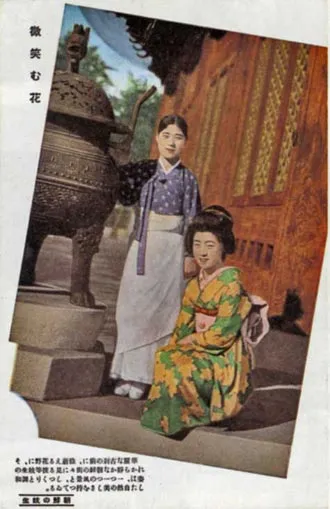
Postcard showing a Korean kisaeng and a Japanese geisha, two iconic figures rarely juxtaposed in visual media. Reproduced in the book Kiisen: “mono iu hana” no bunkashi by Kawamura Minato (Tokyo: Sakuhinsha, 2001; plate 10)
Editor: Erind Pajo
Primitive Selves
E. Taylor Atkins Primitive Selves: Koreana in the Japanese Colonial Gaze, 1910-1945 University of California Press 280 pages, 9 x 6 inches ISBN 978 0520266735 ISBN 978 0520266742
Available here →November 24, 2010
20101124-atkins-taylor-on-primitive-selves-koreana-japanese-colonial-gaze-1-1
In a nutshell
The rest of this thread

E. Taylor Atkins
E. Taylor Atkins is Professor and Director of Undergraduate Studies in the Department of History at Northern Illinois University. In addition to Primitive Selves, featured in his Rorotoko interview, Atkins is the author of Blue Nippon: Authenticating Jazz in Japan (Duke University Press, 2001), which won the 2003 John Whitney Hall Prize, and editor of Jazz Planet (University Press of Mississippi, 2003). He also wrote the “Popular Culture” chapter in A Companion to Japanese History (ed. William Tsutsui, Blackwell, 2007), and has published articles in Journal of Asian Studies, American Music, positions, and Japanese Studies.
Pull this thread
Japanese colonial nostalgia turned Korean folk culture into an emblem of Korean nationhood.
Know something the rest of us don't?
Most threads on Rorotoko begin with our invitation. Any thread can begin with a proposal: you write it with the same prompts every thread answers, and we review it.
Propose a thread →