
E. Taylor Atkins
Primitive Selves
The first chapter, “A Long Engagement,” provides a narrative overview of the Japan-Korea relationship until the end of World War II. I could have relied exclusively on secondary works by other historians who have written immense amounts about this period of history. However, I supplemented such work with contemporary reports from the U.S. and Japanese media, to inch somewhat closer in time to the action.
Such sources are not without their own problems, of course. One easily detects racism and outright contempt in them. Nonetheless, in these reports I found so much more texture and color, more impassioned opinions and poignant quotations than any historical narrative provided. This reinforced for me the power of using primary sources as proximate to the events and people as one is able to obtain. The result is a substantially different narrative of colonial Korean history than one is likely to find elsewhere.
Moreover, I reassess the meanings of the slogan “cultural rule” (bunka seiji), used by the Japanese to characterize a shift in colonial policy after the 1919 national uprisings in Korea. I also argue that the desire to document and curate Koreana was an imperative throughout the colonial period, rather than an ephemeral, unsustained project of the purportedly “liberal” 1920s.
Some readers might enjoy chapter 4 the most: this recounts how Korean folk music and dance became mass cultural products in 1930s Japan, around the same time that pressures to assimilate Koreans to Japanese culture intensified.
My intention is to communicate information about the past in a manner that is intelligible, informative, and thought-provoking to non-historians. If the reader also enjoys reading, then so much the better.
One of my fears all along with this project has been that it might offend Koreans. I iterate throughout the book: I am not trying to minimize their national suffering, nor exonerate Japanese somehow by pointing out the affection and interest many of them had in Koreana.
But I am not inclined to endorse or promote Manichean views of life, either in the past or present. I do believe there is good and evil, but I don’t think my primary responsibility as a historian is merely to revere the good and castigate the evil.
I think the message is conveyed more effectively when presented in a calmer, more nuanced way. None of us is anything less than a complex whole, and we do well to acknowledge the comparable complexity of the people whose historical traces we pursue.
Finally, I have pledged to donate 100% of my royalties from Primitive Selves to Tahirih Justice Center, a charity that arranges pro bono legal, social, linguistic, and medical services for immigrant women and girls who are victims of gender-based violence, trafficking, and abuse.
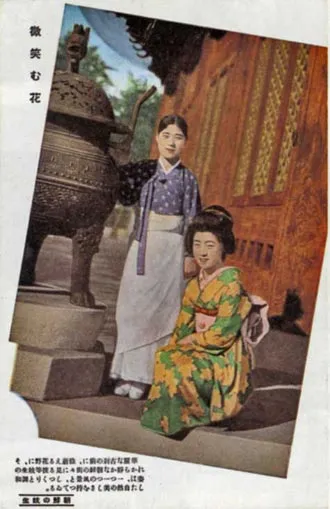
Postcard showing a Korean kisaeng and a Japanese geisha, two iconic figures rarely juxtaposed in visual media. Reproduced in the book Kiisen: “mono iu hana” no bunkashi by Kawamura Minato (Tokyo: Sakuhinsha, 2001; plate 10)
Editor: Erind Pajo
Primitive Selves
E. Taylor Atkins Primitive Selves: Koreana in the Japanese Colonial Gaze, 1910-1945 University of California Press 280 pages, 9 x 6 inches ISBN 978 0520266735 ISBN 978 0520266742
Available here →November 24, 2010
20101124-atkins-taylor-on-primitive-selves-koreana-japanese-colonial-gaze-3
A close-up
The rest of this thread

E. Taylor Atkins
E. Taylor Atkins is Professor and Director of Undergraduate Studies in the Department of History at Northern Illinois University. In addition to Primitive Selves, featured in his Rorotoko interview, Atkins is the author of Blue Nippon: Authenticating Jazz in Japan (Duke University Press, 2001), which won the 2003 John Whitney Hall Prize, and editor of Jazz Planet (University Press of Mississippi, 2003). He also wrote the “Popular Culture” chapter in A Companion to Japanese History (ed. William Tsutsui, Blackwell, 2007), and has published articles in Journal of Asian Studies, American Music, positions, and Japanese Studies.
Pull this thread
Japanese colonial nostalgia for Korean folk culture turned it into the emblem of nationality for post-liberation Korea.
Know something the rest of us don't?
Most threads on Rorotoko begin with our invitation. Any thread can begin with a proposal: you write it with the same prompts every thread answers, and we review it.
Propose a thread →