
Timothy Snyder
Bloodlands
I'm a historian of eastern Europe, I'm a specialist in this region.I've noticed that in general my colleagues avoid the larger tragedies that struck the lands we've studied, such as the Holocaust or Soviet Terror.
Historians who write about the Holocaust usually focus on Germany, which is where the decisions were indeed made, but not where the killing took place. Meanwhile, historians of the Soviet Union usually don't notice that Stalin's killing policies were most lethal in the western Soviet Union.
In other words, we are all researching the Bloodlands, but we have all failed to see the mass death as a single event at a given time and place.
Each of the episodes I discuss in the book—Stalin's famines, Stalin's shooting campaigns, the joint German-Soviet occupation of Poland, the German starvation of Soviet POWs, the Holocaust—has its own story and its own historiography. But never before have they been brought together.
Partly this is because few people know all of the necessary languages, partly this is because many fear to compare Nazi Germany and the Soviet Union.
My own main purpose was not to compare, but rather to chronicle the individual killing policies of each regime.
What I found was that the interactions between Nazi Germany and the Soviet Union were very often deadlier than anything one regime would have done on its own.
The avoidance of comparison is a luxury in which we can indulge if we wish. The millions of Jews, Ukrainians, Poles, Belarusians, Russians and other Europeans touched by both regimes were condemned to compare.
Editor: Erind Pajo
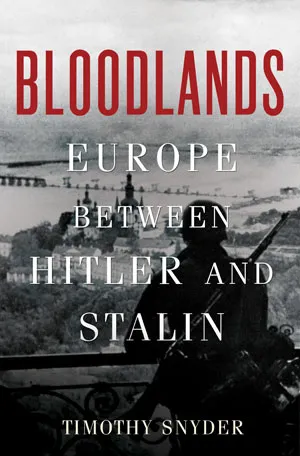
Bloodlands
Timothy Snyder Bloodlands: Europe Between Hitler and Stalin Basic Books 544 pages, 9 1/4 x 6 1/8 inches ISBN 978 0465002399
Available here →November 29, 2010
20101129-snyder-timothy-on-bloodlands-europe-between-hitler-stalin-2
The wide angle
The rest of this thread
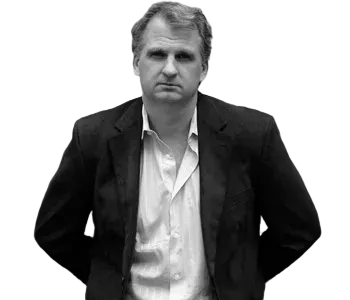
Ine Gundersveen
Timothy Snyder
Timothy Snyder is professor of history at Yale University, and the author of a number of award-winning studies of central and east European history, including Sketches from a Secret War, The Reconstruction of Nations, and The Red Prince. He is also a frequent contributor to The New York Review of Books.
Pull this thread
pulls againstpulls alongside
The fourteen million murdered between Berlin and Moscow from 1933 to 1945 died in a single event.
Against EC · American houses were shaped by food, by dwellers rearranging space for storing, preserving, cooking and serving it. On: Historical meaning lies in exceptional events rather than in the texture of ordinary life
Against LB · Staying attached to what wears you out is the structure of optimism, not irrationality. On: Historical meaning lies in exceptional events rather than in the texture of ordinary life
Against AA · Photography constitutes a citizenry no sovereign can close, and watching is a duty the governed owe one another. On: Historical meaning lies in exceptional events rather than in the texture of ordinary life
Alongside JE · Lincoln's rise was contingent, and the sense of its inevitability is an artifact of how 1860 is taught. On: Historical meaning lies in exceptional events rather than in the texture of ordinary life
Alongside WS · Every cause of the Great Divergence is downstream of one condition, that no empire like Rome ever returned to Europe. On: Historical meaning lies in exceptional events rather than in the texture of ordinary life
Alongside FD · The Great Leap famine was mass murder, not miscalculation, and at least 45 million died. On: Historical meaning lies in exceptional events rather than in the texture of ordinary life
Nearby AB · The Soviet Union ended the Cold War by choice, while still at military parity with the United States.
Know something the rest of us don't?
Most threads on Rorotoko begin with our invitation. Any thread can begin with a proposal: you write it with the same prompts every thread answers, and we review it.
Propose a thread →