
Robert C. Smith
Conservatism and Racism and Why in America They Are the Same
A section of Chapter 8 on the ascendancy of Reagan to the presidency is titled “It’s the Ideology, Stupid.” President Reagan is a central character in the book, because he is undoubtedly the most significant conservative leader of the present era and one of the most significant in American history.Reagan was frequently accused of being a racist. Nothing angered him more. As he writes in his presidential memoir “the myth that has always bothered me the most is that I am a bigot who somehow surreptitiously condones racial prejudice… Whatever the reason for this myth that I am a racist, I blow up every time I hear it.”In close, careful study of the biographical and historical records, I found no evidence that Reagan was a racist or white supremacist. It was Reagan’s principled, ideological conservatism that led him to oppose every civil rights bill enacted in the 1960s.Reagan’s opposition to the Civil rights Act of 1964 and the Voting Rights Act of 1965 was based on the conservative principles of limited government and states’ rights. In California he opposed the state’s Fair Housing Act on the conservative principles of individualism and property rights, declaiming that the right of an individual to dispose of his property as he wished was “a basic human right.”Reagan prioritized these conservative ideological principles over the human rights of African Americans to be served at a Georgia BBQ joint, to vote for president in Alabama or to purchase a house in California. In doing so, he clearly made conservatism and racism the same.As if to symbolize this relationship, Reagan’s first campaign appearance after he received the Republican nomination in 1980 was in Philadelphia, Mississippi. Philadelphia was the site of the 1964 murder of three civil rights workers by the Ku Klux Klan. In his Philadelphia speech Reagan invoked states rights, code words in the South for the right of whites to oppress blacks.The public, politicians and the media are often puzzled by the consistent failure of conservatism to have much appeal to African Americans. This book provides the answer to those puzzles.I decided to write the book shortly after Ronald Reagan’s funeral. In the long lines of mourners that gathered to pay their respects to the President at the Capitol in Washington and the presidential library in Simi Valley, California there were very few African Americans.In the course of the nearly week long commemoration of Reagan’s life and legacy—where he was lauded as one of the nation’s greatest presidents—I was asked in the media to explain the absence of black mourners in Washington and Simi Valley. My explanations dealt less with Reagan as an individual or as president than with conservatism as a philosophy and ideology.Ronald Reagan was not mourned by many African Americans because he was a conservative; the most successful conservative president of the post civil rights era and one of the most successful conservative presidents in the 20th century. Conservatism as a philosophy and ideology, I explained, are and always have been hostile to the aspirations of Africans in America; incompatible with their struggle for freedom and equality. Thus, very few blacks could mourn the passing of a man who was an icon in the cause of 20th century American conservatism.In the nature of modern media it was difficult to convey this rather complex idea in a brief interview. I found that even in extended interviews it was difficult to fully explore this complex relationship between conservatism and black aspirations.Repeatedly, I was asked: Are you saying that conservatism is racism? That all conservatives are racist? Aren’t there black conservatives? Are they racist? Are the millions of Americans who supported President Reagan racist? Are President George W. Bush and the conservatives who control the Congress and the courts hostile to African American interests?My answer to most of these questions was a qualified yes. But the many qualifications and caveats left me, the interviewers, and the audience, without the kind of clarity one would hope for when professors are called upon to explain complex issues to the public. Thus, this book.
Editor: Erind Pajo
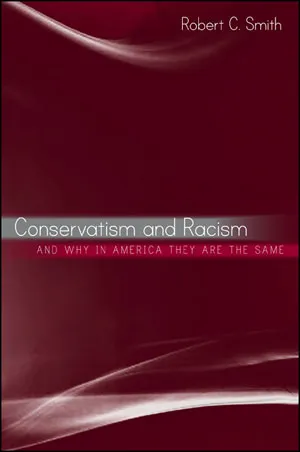
Conservatism and Racism and Why in America They Are the Same
Robert C. Smith Conservatism and Racism and Why in America They Are the Same SUNY Press273 pages, 9 x 6 inches ISBN 978 1438432335
Available here →December 6, 2010
20101206-smith-robert-on-conservatism-racism-why-america-they-are-same-3
A close-up
The rest of this thread

San Francisco State University
Robert C. Smith
Robert C. Smith is professor of Political Science at San Francisco State University. He received his undergraduate degree from UC Berkeley and his graduate degrees from UCLA and Howard University. Besides Conservatism and Racism and Why in America They Are the Same, Smith is also the author of the Encyclopedia of African-American Politics, scores of articles and essays, a dozen books, and the just-completed manuscript The Politics of Ethnic Incorporation and Avoidance: The Elections and Presidencies of John F. Kennedy and Barack Obama. In 1998 he was awarded Howard University’s Distinguished Ph.D. Alumni Award.
Pull this thread
American conservatism's ideals, applied consistently, inevitably produce racism, because what was established here was white supremacy.
Know something the rest of us don't?
Most threads on Rorotoko begin with our invitation. Any thread can begin with a proposal: you write it with the same prompts every thread answers, and we review it.
Propose a thread →