
Ann Fabian
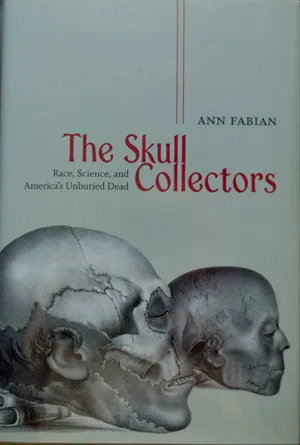
The Skull Collectors
When he died in 1851, Samuel George Morton, a Philadelphia doctor, left behind a collection of more than a thousand human skulls. Not the grisly byproduct of botched operations, but the fruit of 20 years’ work gathering up human remains from around the world. Friends sent Morton heads from Peru, Cuba, Mexico, and Liberia, from almshouses in Pennsylvania, swamps in Florida, beaches in Hawaii, gallows in Indonesia, tombs in Egypt, and battlefields in Texas.
Naturalists, like Morton and his friends, collected plants and animals and helped catalogue America’s flora and fauna. But trafficking in human bodies was a strange business, and they knew it. They were sure that human skulls held clues to the riddles of racial difference—a question that took on increasing urgency in a generation that both argued over slavery and tried to map the world’s populations.
Were human beings all one species? After measuring many skulls, Morton thought not. He published two books that laid out the measurements work behind his conclusion that Caucasians, with big heads, were meant to rule the world.
We know a lot about the bad science behind Morton’s theories of racial hierarchy. But I was interested in something else. I wrote The Skull Collectors because I was curious about the skulls. Whose remains wound up on shelves in Philadelphia? Why?
As I traced their stories, I realized that the collected dead came from communities torn up by war, removal, conquest, and disease, from places where people, poor and devastated, could not bury or care for the dead. Currents of a global history ran through Morton’s Philadelphia cabinet, and they carried human skulls—debris from conquered places.
Morton died a decade before the United States went to war over the slave system his arguments about race helped to support. He did not live to see his own son numbered among the Union dead. But the skull work he had begun got a boost from the war, as the remains of soldiers, unclaimed by relatives or friends, filled cabinets in an Army Medical Museum.
Skull collecting did not stop when the guns fell silent. Residents in eastern states set about sorting and burying the war’s dead. Something else happened in the west. In the 1870s, the U.S. Army took the war to the plains, and collectors added thousands of Native American dead to museum shelves. In their anxious attention to the fate of Civil War dead, historians have overlooked a history of native dead.
To Army collectors, to Morton and his friends, working with skulls seemed like a good thing to do, but their work has left behind a legion of unburied dead that have come to haunt us.
Editor: Erind Pajo
The Skull Collectors
Ann Fabian The Skull Collectors: Race, Science, and America’s Unburied Dead University of Chicago Press 272 pages, 9 x 6 inches ISBN 978 0226233482
Available here →December 15, 2010
20101215-ann-fabian-on-skull-collectors-race-science-america-unburied-dead-1-1
In a nutshell
The rest of this thread
Ann Fabian
Ann Fabian is a Professor of History and American Studies at Rutgers, the State University of New Jersey, where she recently completed a term as dean of humanities. She has written on gambling, personal narratives, muscleman Bernarr Macfadden’s publishing empire, the quarrel over Kennewick Man, bodies floating in flooded New Orleans, and the failed banks of 1930s America. The School for Advanced Research, the American Antiquarian Society, and the John Simon Guggenheim Foundation supported her research on The Skull Collectors.
Pull this thread
Morton's thousand skulls are debris from conquered places where people were too devastated to bury their own dead.
Know something the rest of us don't?
Most threads on Rorotoko begin with our invitation. Any thread can begin with a proposal: you write it with the same prompts every thread answers, and we review it.
Propose a thread →