
Ann Fabian
The Skull Collectors
It seems pretty clear that none of those whose skulls wound up on museum shelves imagined their body parts cleaned, measured and put on display. To figure out what nasty twists of fate got a skull into a collection, I spent time unearthing the stories of two extraordinary men whose paths crossed with skull collectors.
One of them was a young man from Oregon named Stum-ma-nu. Like many of the native peoples of the Columbia River, Stum-ma-nu had an artificially flattened head. Methodist missionaries brought Stum-ma-nu, very much alive, to the eastern United States and introduced him to Dr. Morton and his naturalist friends. They knew that if Stum-ma-nu were to die, his flattened skull would be a fine prize for a lucky collector.
Audiences flocked to hear the young man describe his Christian faith and to praise the work of American missionaries. They also gawked at his curiously flattened head. But a winter’s sermonizing wore out the young man, and he died in the spring of 1839. Collectors coveted his head. Only a chance encounter with a crusty New York doctor assured the young man the good Christian burial he had said he expected.
A man from Fiji, who died in New York just three years later, was not so fortunate. His body was buried in the cemetery of the Brooklyn Navy Yard, but his head went to the new Smithsonian collections in Washington. It’s still there.
The unlikely story of Ro-Veidovi’s skull begins with the American traders who ventured to Fiji, trying to make a little money in the sea-slug trade. The slimy creatures, aphrodisiacs some believed, sold well in Chinese markets. Looking for profits from sea slugs, American traders bungled into Fiji’s local politics and a batch of sailors died at native hands.
A few years later, American explorers arrested Ro-Veidovi for these murders and brought him back to the United States to teach him lessons about all the good things likely to come to Fijians who helped out traders and explorers from the United States. Ro-Veidovi died the day he arrived in New York, taught only what he might have learned from sailors on a long voyage back from the Pacific. Like Stum-ma-nu, Ro-Veidovi died far from home, and his body was buried in a fashion that could only have surprised him.
The Skull Collectors gathers stories that mix the scientific aspirations of explorers and collectors, the hopes of missionaries and converts, and the histories of people from places as different as the banks of the Columbia River and the shores of Fiji.
Why do these stories matter? Any cultural historian would be struck by the differences between the skull collectors’ nineteenth-century world and our own. It no longer seems right to collect and display the remains of native dead, however curious we might be about what the bones might tell us.
The scientific collectors I write about collected remains from around the world, but the bodies of Native American dead dominated their collections. Telling the story of the collection and repatriation of these remains, historians often have given the native dead a special status. But this approach has missed the important ways the history of skull collecting tells a universal human story about loss, memory, and the need to bury the dead.
It is surprising what we learn when we pay attention to the dead.
Editor: Erind Pajo
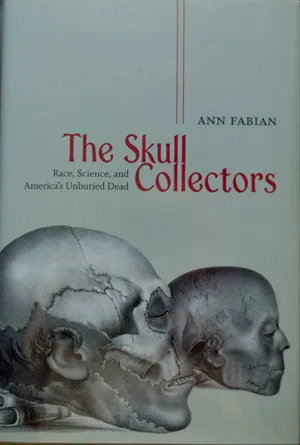
The Skull Collectors
Ann Fabian The Skull Collectors: Race, Science, and America’s Unburied Dead University of Chicago Press 272 pages, 9 x 6 inches ISBN 978 0226233482
Available here →December 15, 2010
20101215-ann-fabian-on-skull-collectors-race-science-america-unburied-dead-3
A close-up
The rest of this thread

Ann Fabian
Ann Fabian is a Professor of History and American Studies at Rutgers, the State University of New Jersey, where she recently completed a term as dean of humanities. She has written on gambling, personal narratives, muscleman Bernarr Macfadden’s publishing empire, the quarrel over Kennewick Man, bodies floating in flooded New Orleans, and the failed banks of 1930s America. The School for Advanced Research, the American Antiquarian Society, and the John Simon Guggenheim Foundation supported her research on The Skull Collectors.
Pull this thread
Morton's thousand skulls are debris from conquered places where people were too devastated to bury their own dead.
Know something the rest of us don't?
Most threads on Rorotoko begin with our invitation. Any thread can begin with a proposal: you write it with the same prompts every thread answers, and we review it.
Propose a thread →