
David C. Kang
East Asia Before the West
My book set out to answer one general and seemingly simple question: How did international relations function in East Asia from the fourteenth century to the nineteenth, before the arrival of the Western imperial powers?
I make one overarching argument: that East Asian international relations exhibited two historical patterns, both of which were different from the European experience with the “balance of power.” The four main states of historical East Asia (Korea, Vietnam, Japan, and China) had generally stable and clear borders with each other and very little war. At the same time, the four states had endemic conflict with the various “nomadic” tribes and groups which existed along a vast frontier zone.
In explaining this pattern, I argue that a set of international rules and institutions—known as the tribute system—governed the relations of the East Asian states during this time period.
Emphasizing formal hierarchy and yet allowing considerable informal autonomy, Korea, Vietnam, Japan, and China had considerable peace and stability in their relations with each other. By contrast, the European “balance of power” system emphasized formal equality of nation-states, but entailed endemic conflict among states.
Yet not all polities in East Asia played by the tribute system rules. The most fighting and problems occurred between these historical East Asian states and the nomads on their northern and western frontiers.
The system comprised more than just war and diplomacy. Historical East Asia was also an economic international system, with extensive trade relations and cultural exchange among all the units in the region. China, the hegemon, was more than just a political power. From Siam to Java, to Vietnam, Taiwan, and even Japan, all the states traded with each other and particularly with China.
It is common to use analogies from nineteenth century Europe—such as the rise of Bismarckian Germany—to explain East Asian relations in the twenty-first century. I hope this book contributes to viewing East Asia actually as a region of its own—with different states and distinct patterns, and not simply as a reflection of the Western experience.
Today there is intense interest in whether these states can craft a stable relationship, especially with China’s emergence as an economic powerhouse. Given that they have centuries of history together, it is logical to ask how their relations worked in the past and whether this tells us anything about the present.
Editor: Erind Pajo
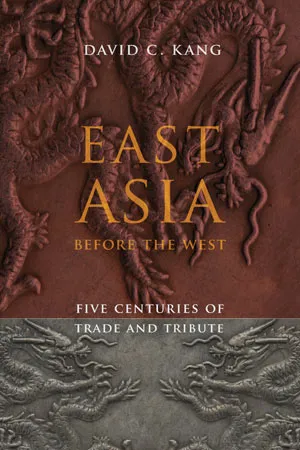
East Asia Before the West
David C. Kang East Asia Before the West: Five Centuries of Trade and Tribute Columbia University Press 240 pages, 9 x 6 inches ISBN 978 0231153188
Available here →January 24, 2011
20110124-kang-david-east-asia-before-west-five-centuries-trade-tribute-1-1
In a nutshell
The rest of this thread

David C. Kang
David C. Kang is Professor in the School of International Relations and in the Marshall School of Business at the University of Southern California, and director of the USC Korean Studies Institute. Besides East Asia Before the West, featured in his Rorotoko interview, Kang is also the author of China Rising (Columbia, 2007), Crony Capitalism (Cambridge, 2002), and, with Victor Cha, of Nuclear North Korea (Columbia, 2003). Kang has published numerous articles in journals such as International Organization and International Security, and opinion pieces in the New York Times, the Financial Times, the Washington Post, and the Los Angeles Times. He received an A.B. with honors from Stanford and a Ph.D. from Berkeley.
Pull this thread
The tribute system kept East Asia's core states almost at peace with one another for five centuries.
Know something the rest of us don't?
Most threads on Rorotoko begin with our invitation. Any thread can begin with a proposal: you write it with the same prompts every thread answers, and we review it.
Propose a thread →