
Martin Bojowald
Once Before Time
This book contains a chapter on cosmology from a wide perspective. Before the scientific method was used to understand the universe, various cultures across the globe developed their own theories on the origins of the cosmos. The story began with myths and pre-Socratic philosophy, and continued until roughly one hundred years ago, when science became sophisticated and confident enough to answer many questions about the universe.
As opposed to science’s outward exploration of the cosmos, previous cultures relied on introspection, and projected their own cultural bias onto the universe. Using their cosmic models, we can appreciate human nature, and a less systematic approach to follow logical conclusions.
Even though we could view ancient ideas with condescension today, perceiving them as simple-minded, ancient ideas remain an important part of humankind’s natural drive to understand the world. This desire, which we share with past cultures, continues to propel our exploratory endeavors, scientific and cultural.
Searching for the universe’s origins, over the last thousands of years, has been an issue of outstanding importance in different ways. Rightfully or not, different schools of thought regarding the origin have served to consolidate power in or between cultures. By looking closely at different versions of myths or early philosophical ideas, one can surmise how the all-too-human nature enters the game. Sometimes modern physics follows this tradition—using different means, such as mathematical machinery, to solidify professional prowess.
Human imagination does not seem inventive enough to produce entirely novel, crucial differences in our theories of how the universe began. Several aspects in contemporary cosmological scenarios are simply derivative of past ideas—even while more details are being filled in and deeper explanations provided.
Nevertheless, when one considers the history of cosmology, science clearly has an unbeatable advantage, because it gives us a means to test our theories by independent observation and critique.
In a larger context—if there could possibly be a larger context than the history of the whole universe—Once Before Time illustrates the process of science. It reveals the progress science has made at its essence.
However, this very context highlights the limits of science as well. Some recent dreams have been shattered; a closer view of the scientific events often provides humbling lessons.
I don’t mean to condone any alternatives to science—for there is no alternative to understanding the world. But these arguments show that science, even at its greatest success, cannot supersede all other methods of human inquiry.
Once Before Time describes what has been proposed toward a “theory of everything,” the grand attempt to uncover laws that govern everything in the universe, from the largest to the smallest bits.
Modern physics has ventured to unbelievable extremes.
Skillful application of mathematics now seems the only reliable tool for understanding the universe’s underlying structures: the fundamental nature of matter and the behavior of entire galaxies. As a final consequence, what was previously considered impossible, knowing anything that happened before the big bang, becomes feasible.
Mathematical theory creates a bridge between the atomic, elementary world and the behaviors of the entire universe, with us humans lost somewhere in between. And yet, human nature continues to play a role behind the scenes.
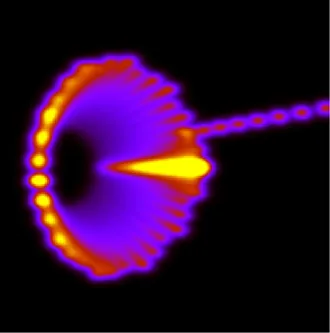
Illustration of a model universe, spiraling out of nothingness (the so-called “State of Hell” of Loop Quantum Gravity) and then rapidly expanding to the right. The figure overlays states of the early universe at all times, characterized by its extension (vertical axis) and expansion rate (horizontal axis). Brighter colors correspond to states occupied more often. (Martin Bojowald)
Editor: Erind Pajo
Once Before Time
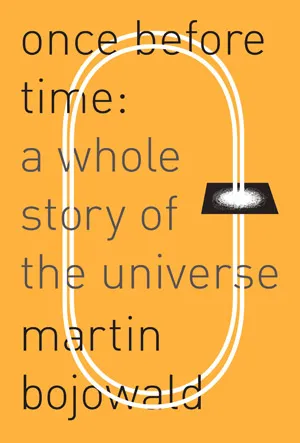
Martin Bojowald Once Before Time: A Whole Story of the Universe Alfred A. Knopf 320 pages, 6¼ x 9¼ inches ISBN 978 0307272850
Available here →March 9, 2011
20110309-bojowald-martin-on-once-before-time-whole-story-universe-3
A close-up
The rest of this thread
Martin Bojowald
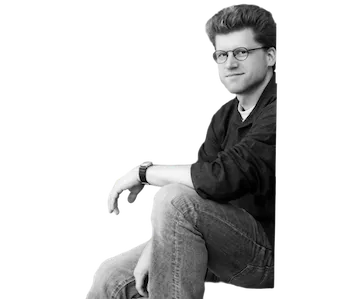
Martin Bojowald is an Associate Professor of Physics at the Pennsylvania State University. He received his Ph.D. in 2000, for work that founded the field of Loop Quantum Cosmology, and has received several awards and distinctions for his research, teaching and service to the science community. Once Before Time, featured in his Rorotoko interview, is based on a book he published in Germany in 2009, which became a bestseller.
Pull this thread
The big bang was not the beginning of the universe or of time.
Know something the rest of us don't?
Most threads on Rorotoko begin with our invitation. Any thread can begin with a proposal: you write it with the same prompts every thread answers, and we review it.
Propose a thread →