
Daniel T. Rodgers
Age of Fracture
Age of Fracture began in my attempts to explain modern America to myself and to my students. Having made a pledge that I would take my courses right up to the present moment, I spent much of this era trying to figure out what was happening as the world shifted beneath us.
Conservative writers rejoiced that the nation was finally coming to its senses after the cultural upheavals of the 1960s. Liberals protested that the new-right think tanks were simply putting into circulation the best pseudo-ideas their money could by. Neither explanation worked for me. Both liberalism and conservatism were transformed in these years, and there were sometimes uncanny resemblances and crossovers in their remaking.
The nation was not becoming, in any straightforward way, more conservative. It was becoming something unprecedented. It was thinking in smaller, more individualist pieces than at any earlier time in its modern history. It was trying to get through the extraordinary hazards of the late twentieth century with fragments.
There were fractures on the ground of society and politics, too.
The polarization of the media as the Walter Cronkite generation of news broadcaster passed from the scene was a striking fact of the age. With the breakup of network television into wired-in, micro-communities of like-minded others, arguments became more shrill and polarized. Secession is in the air once again. Communities have walls, gates, and security guards.
But this is not as unusual in American history as it appears. Social and political polarization has been a fact of much of our past. It is not to be dismissed. What is new is the very fracturing of the words and categories by which we try to grasp social reality.
Editor: Erind Pajo
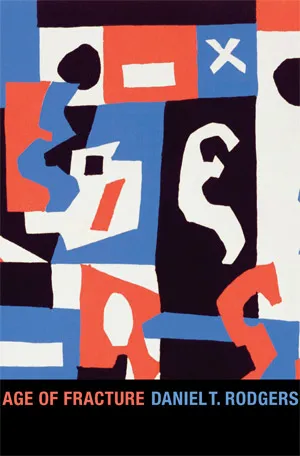
Age of Fracture
Dan Rodgers Age of Fracture Belknap Press of Harvard University Press 360 pages, 6 1/4 x 9 1/4 inches ISBN 978 0674057449
Available here →March 30, 2011
20110330-daniel-rodgers-on-age-of-fracture-2
The wide angle
The rest of this thread

Daniel T. Rodgers
Dan Rodgers is an historian of American ideas and culture. He has taught at the University of Wisconsin and, for the last thirty years, at Princeton, where he is the Henry Charles Lea Professor of History. He is the author of The Work Ethic in Industrial America, 1850-1920 (1976), Contested Truths: Keywords in American Politics since Independence (1987), Atlantic Crossings: Social Politics in a Progressive Age (1998), and Age of Fracture (2011), featured in his Rorotoko interview. He is the winner of book awards as well as teaching prizes. He has been a Fulbright lecturer in Germany and Japan and the Pitt Professor of American History and Institutions at Cambridge University. Dan Rodgers is a member of the American Academy of the Arts and Sciences.
Pull this thread
Between the mid-1970s and 2001 the words Americans used to grasp society broke into smaller pieces.
Know something the rest of us don't?
Most threads on Rorotoko begin with our invitation. Any thread can begin with a proposal: you write it with the same prompts every thread answers, and we review it.
Propose a thread →