
Robert Wuthnow
Remaking the Heartland
One of the best examples of how the heartland is changing can be found near Kansas City, in Johnson County, where builders are putting together new housing developments and constructing highways at a frenetic pace.
Since 1970, Lenexa has grown from about 5,000 to almost 50,000, Leawood has climbed from 10,000 to 32,000, and Olathe has soared from 18,000 to more than 125,000. By 2040, Olathe’s population is expected to top 300,000.
This is hardly what one would expect in a state with fewer than 3 million people, where 70 percent of the towns were smaller in 2005 than they were in 1980.
But Johnson County is the home of high-tech companies like Sprint and Garmin and scores of pharmaceutical and bioscience firms; it headquarters dozens of major retail, warehousing, and distribution companies. Johnson County is a magnet not only for well-educated young people with small town roots, but also for migrants from other regions. Nearly half of its population was born in another state.
Growth like this is happening throughout the heartland—in Minneapolis and St. Paul, along Interstate 70 west of St. Louis, near Omaha and Tulsa, around Des Moines, and in northwest Arkansas.
Entrepreneurs like Sam Walton, John Tyson, Warren Buffett, and David and Charles Koch are part of the story. And yet, there is another story that involves visionaries a century ago—those who experimented with engines and aviation, who planned street car lines, and who benefited from even earlier efforts to start schools and found colleges. It was those early institutions that provided the groundwork for the more recent transformations.
I came away with an optimistic appraisal of what is happening in this part of America’s heartland.
To be sure, population is not growing like it is on either coast. Jobs are often scarce and rising fuel prices make long commutes difficult. Children grow up and seldom return.
Yet, the region’s contribution to the national economy remains undiminished. Effective adaption is happening everywhere one looks—from GPS-guided tractors, to wind energy farms, to bioscience laboratories. The heart of the heartland is beating strong.
Much of the reason lies in the enduring social institutions the region’s residents built from the 1870s to the 1950s. These included an effective system of county and township government, and especially of primary and secondary schools.
By the 1920s, the Middle West had become known as the “education belt.” Over the next half century, it added a large network of colleges and universities, pioneered the nation’s aviation industry, adapted to international markets, and rebuilt its infrastructure. Not surprisingly, the people I talked to expressed pride in their communities and voiced cautious optimism about their place in America’s future.
Is there a policy message in all this? Perhaps.
Pundits describe the heartland as a hotbed of anti-government fiscal conservatism. And that may be true.
But over the past century and a half government has played an enormously important role in the heartland. Before the pioneers arrived, the government surveyors, land agents, and cavalry prepared the way. County and township governments formed, regulated and taxed the use of land, and supervised the orderly development of primary and secondary schools. World War Two filled the region with ammunition depots and military bases that gave fledgling companies their start and created lasting infrastructure for new businesses.
The heartland is currently involved in the nation’s struggle to rebuild its infrastructure and avoid further economic catastrophe while paying heed to the demands of social conservatives and Tea Party activists.
It may be tempting to think of the heartland as a kind of hinterland, still populated with indigent hayseeds too poor to take advantage of progress in the nation’s great cities. But to think that would be a big mistake.
Editor: Erind Pajo
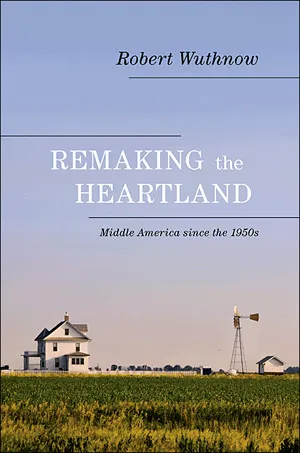
Remaking the Heartland
Robert Wuthnow Remaking the Heartland: Middle America since the 1950s Princeton University Press 376 pages, 6 x 9 inches ISBN-978 0691146119
Available here →April 27, 2011
20110427-wuthnow-robert-remaking-heartland-middle-america-since-1950s-3
A close-up
The rest of this thread

Robert Wuthnow
Robert Wuthnow is Andlinger Professor of Social Sciences and chair of the Sociology Department at Princeton University. He is the author of more than two dozen books. The book he is currently writing, Red State Religion, traces the history of religion and politics in Kansas from Abraham Lincoln’s visit in 1859 to the murder of Dr. George Tiller in 2009. Wuthnow’s grandfather lived in Olathe, Kansas, when the town’s inhabitants numbered fewer than 3,000.
Pull this thread
The middle of the country has not declined, it has remade itself.
Know something the rest of us don't?
Most threads on Rorotoko begin with our invitation. Any thread can begin with a proposal: you write it with the same prompts every thread answers, and we review it.
Propose a thread →