
Richard Pells
Modernist America
Chapter One, “Modernism in Europe and America,” outlines the book’s major arguments. It also focuses on the urban aspects of modernism, the cultural importance of cities like Vienna, Berlin, Paris, and New York. The chapter deals as well with the devastating carnage of World War I, and the ways that modernist artists and intellectuals—from Picasso to Hemingway—felt that they had to invent new ways of seeing, talking, and hearing to express the upheavals of the modern world.Chapter Eleven, “The New Wave at Home,” explores the renaissance in American filmmaking from the late 1960s to the beginning of the 1980s. It is in this chapter that I trace the impact of French and Italian filmmaking on a new generation of American directors: Francis Ford Coppola, Robert Altman, Woody Allen, Sam Peckinpah, Martin Scorsese, Bob Fosse, Steven Spielberg. These were the years when American movies—from The Godfather to Annie Hall to Nashville to The Deer Hunter—captured the imagination of audiences throughout the world, and made American films the center of world cinema.Chapter Twelve, “A Method They Couldn’t Refuse,” analyzes the emergence and techniques of a new generation of American actors who have dominated the theater and movies for the past 60 years: Marlon Brando, Montgomery Clift, Robert De Niro, Al Pacino, Meryl Streep, Dustin Hoffman, Jack Nicholson. The entire second half of the book deals with the history of Hollywood—as an immigrant industry, as a business, as global entertainment, and above all as the most important form of art in the 20th century. In sum, any reader who loves movies will find this book a treasure of analysis, stories, and interpretations, spanning from Citizen Kane and Casablanca to Bonnie and Clyde and Titanic.The significance of Modernist America is in its scope, and its effort to tie together developments in all the arts and in most forms of entertainment.Too often, modern American historians do not concentrate on cultural developments, nor do they approach their work from a comparative perspective. In a sense, they are too insular.What I have tried to do is provide just such a comparative, global, point of view—and remind us all that trends in culture are as important as political and social events. Cultural developments define a country and a world every bit as much as economic and military crises.So for any reader who cares about the arts, or who just loves to be entertained by a movie, Modernist America may well be the book for you.
Editor: Erind Pajo
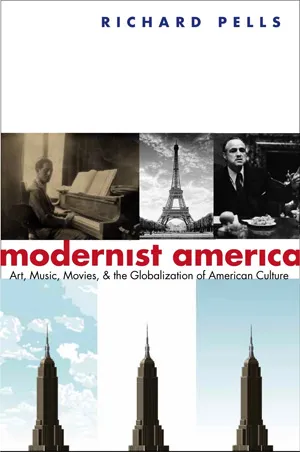
Modernist America
Richard Pells Modernist America: Art, Music, Movies, & the Globalization of American Culture Yale University Press496 pages, 6 1/8 x 9 1/4 inches ISBN-978 0300115048
Available here →May 30, 2011
20110530-pells-richard-modernist-america-art-music-movies-global-culture-3
A close-up
The rest of this thread

Richard Pells
Richard Pells is a Professor of History Emeritus at the University of Texas at Austin. He is the author of four books on American culture. He has held fellowships from the Guggenheim Foundation and the Woodrow Wilson International Center for Scholars, as well as six Fulbright chairs and senior lectureships. Richard Pells has been a visiting professor in Amsterdam, Copenhagen, Berlin, Cologne, Bonn, Vienna, Finland, Sao Paulo, Sydney, and Indonesia. He is currently writing a book called War Babies about the past and present impact on American culture and politics of the generation of Americans born during World War II.
Pull this thread
American culture conquered the world because it was never purely American, having borrowed European high modernism first.
Know something the rest of us don't?
Most threads on Rorotoko begin with our invitation. Any thread can begin with a proposal: you write it with the same prompts every thread answers, and we review it.
Propose a thread →