
Stuart Banner
American Property
Chapter 7, “Owning Fame,” is about the rise of property rights in the names and images of famous people. I bookend the chapter with the stories of two celebrities, Jenny Lind and Elvis Presley.
Lind was the blockbuster performer of the mid-nineteenth century. Her 1850-1852 tour of the United States packed concert halls from New York to New Orleans and back again.
Lind’s promoter was P.T. Barnum, no stranger to innovative ways of making money. Everywhere the tour went, shopkeepers were selling Jenny Lind merchandise. “We had Jenny Lind gloves,” Barnum recalled, “Jenny Lind bonnets, Jenny Lind riding hats, Jenny Lind shawls, mantillas, robes, chairs, sofas, pianos.” There were Jenny Lind stoves and even Jenny Lind chewing tobacco and cigars, despite Lind’s aversion to cigars.
Yet none of these products earned Lind or Barnum a cent. Lind’s celebrity was obviously a valuable asset—but neither Lind nor Barnum conceived that Lind had any right to prevent others from commercially exploiting her name or image.
None of the manufacturers or sellers of Jenny Lind merchandise thought he needed Lind’s permission. Indeed, Barnum was happy so many people were slapping Lind’s name on their products, because it was proof of her popularity, which promised that the concerts would sell out. It apparently never occurred to him that they were taking money out of Lind’s pocket.
A hundred years later, a new kind of property had come into existence. When Elvis Presley toured the country in the 1950s, he likely earned more from licensing fees than from ticket sales. There were Elvis shoes, Elvis jeans, Elvis record players, Elvis bracelets, Elvis lipstick, Elvis statues in plaster of Paris, and much more.
By 1956, still very early in Elvis Presley’s career, thirty companies had fifty licenses for Elvis products to be sold in the country’s leading department stores. Presley’s licensing agent was Henry G. Saperstein of Beverly Hills, whose other clients included Lassie and the Lone Ranger.
Back in the 1850s, P.T. Barnum had been pleased to discover unauthorized Jenny Lind merchandise. In the 1950s Saperstein sometimes discovered unauthorized Elvis gear, and when he did, “we sue like mad,” he explained. “We’ve never lost a case yet. The courts protect you all the way.”
Philosophers and law professors sometimes try to discern property’s “true” nature. But the stories in this book suggest that property is not something that has a true nature.
What one thinks property is depends on what one wants property to do—that is, what goals one is trying to advance by thinking of property in a particular way.
Property is not an end in itself but rather a means to many other ends. Because we have never had unanimity on how to prioritize those other ends, we have never had unanimity on an understanding of property.
In the course of this push and pull, advocates on all sides have made, and still make, claims about property—about its origins, about its attributes, about its purposes, and about its outer limits. Almost all our discourse about property has consisted, and still consists, of such claims.
The “property” we talk about now, however, is not the same as the property of 1900, which was not the same as the property of 1800. Our conceptions of property have changed over time, to match the changes in the goals we think are worth pursuing.
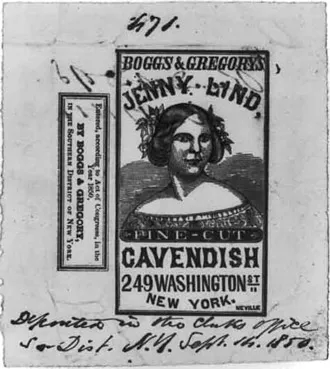
A label for Jenny Lind tobacco, just one of the many unauthorized products bearing her name that Lind encountered on her 1850-52 tour of the United States. (LC-USZ62-86770, Prints and Photographs Division, Library of Congress.)
Editor: Erind Pajo
American Property
Stuart Banner American Property: A History of How, Why, and What We Own Harvard University Press 340 pages, 6 1/8 x 9 inches ISBN 978 0674058057 hb ISBN 978 0674060821 pb
Available here →June 6, 2011
20110606-banner-stuart-american-property-history-of-how-why-what-we-own-3
A close-up
The rest of this thread

Stuart Banner
Stuart Banner is the Norman Abrams Professor of Law at UCLA. Besides Speculation and American Property, featured in his two Rorotoko interviews, he is the author of several other books, including The Death Penalty: An American History, How the Indians Lost Their Land: Law and Power on the Frontier, and Who Owns the Sky? The Struggle to Control Airspace from the Wright Brothers On.
Pull this thread
Property has no true nature.
Know something the rest of us don't?
Most threads on Rorotoko begin with our invitation. Any thread can begin with a proposal: you write it with the same prompts every thread answers, and we review it.
Propose a thread →