
Thomas J. Schaeper
Edward Bancroft
Most historians who have had occasion to mention Bancroft have castigated him as a villainous traitor. Yes, he was a spy, but in my book I argue that he was not a traitor.Edward Bancroft viewed his country as being the British Empire. While he believed that Americans were justified in voicing grievances over matters of taxation and governance, he also believed that Britain and America both would be better served if they stayed united in the Empire.Early responses to my book thus far indicate that another topic that catches attention involves Benjamin Franklin. Some authors have asserted that a man of Franklin’s genius must have known what his friend and assistant was up to; in other words, Franklin might very well have been a partner in Bancroft’s espionage. I devote several pages to this topic, and I hope that I offer a solid rebuttal of this wild sort of speculation.For me, the most interesting aspect of the book is looking at Bancroft’s entire life. He was born to an undistinguished family in Massachusetts and ran off to sea at the age of eighteen. Shortly thereafter he ended up working as a physician on slave plantations in South America. At the age of twenty-two he moved to London and quickly became an author (three books published when he was twenty-four), physician, scientist, businessman, member of the most prestigious scholarly societies, and one of the world’s top authorities on textile dyes.Bancroft’s seven years as a spy were just an interlude in his long scholarly career. He was not exactly a James Bond type. But, of course, the fact that he did not look like a spy made him the perfect spy.Through the nineteenth century his books on politics, natural science, and dyes were widely cited. Both the United States and Britain claimed him as one of their own, for he received entries in Britain’s prestigious Dictionary of National Biography as well as in the Dictionary of National Biography.Only in 1889 did the world discover that Edward Bancroft had been a spy. In that year an American researcher gained access to British diplomatic archives and discovered Bancroft’s hidden story. Since that time American historians have, without exception, used words like immoral, double-dealing, greedy, and murderous to describe him. My book takes a balanced view. He certainly had his flaws, and I can’t explain all of his motivations. But certainly Edward Bancroft was not a vile traitor.I think my book makes some significant contributions in several areas.In my discussion of patriotism and treason, I add to what others have said about the necessity of viewing the American Revolution as a civil war. There are countless examples of families being torn apart, as one person sided with America and another with the mother country. These include Benjamin Franklin and his Loyalist son William and John Jay and his Loyalist brother James. Like perhaps a half million Americans, Edward Bancroft was a Loyalist, not a traitor.Another area of larger significance involves the reasons for Britain’s loss in the war. Britain was the wealthiest country in Europe and had the largest navy in the world. Thanks to Bancroft, it was better informed about Franco-American war plans than was the Continental Congress. So why did Bancroft’s secret intelligence not help to guarantee a British victory?In the book I explain the reasons why the Crown often could not or would not make better use of his information.Partly this has to do with built-in weaknesses in Prime Minister Lord North’s cabinet. Lord North was an indecisive war-time leader and unable to control the conflicting desires of the ministers who worked under him.Also, from the start Britain had little chance to win the war. The Loyalists were never as strong a force as Britain had hoped. Moreover, large as it was, the British navy was stretched thin. It was charged with patrolling the American and French coasts, protecting possessions in the Caribbean, and guarding Britain itself from possible invasions by France and Spain.In many ways, for Britain, the American Revolution was similar to Vietnam for the United States. In both cases a superpower could win major battles and control the big cities, but it could not control the countryside.
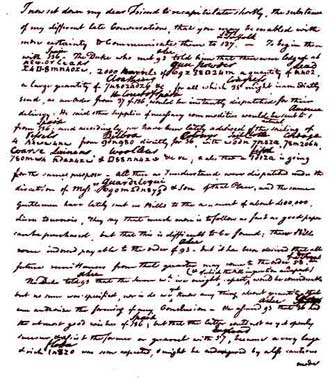
First page of deciphered intelligence sent by Edward Bancroft to London in May 1777. Courtesy of the British Library.
Editor: Erind Pajo
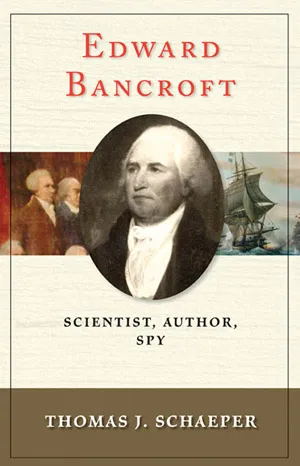
Edward Bancroft
Thomas Schaeper Edward Bancroft: Scientist, Author, Spy Yale University Press352 pages, 6 1/8 x 9 1/4 inches ISBN 978 0300118421
Available here →June 8, 2011
20110608-schaeper-thomas-edward-bancroft-scientist-author-spy-3
A close-up
The rest of this thread

Thomas J. Schaeper
Thomas J. Schaeper received his Ph.D. in history at Ohio State University. Since 1979 he has been a professor of history at St. Bonaventure University, in western New York State. His publications include France and America in the Revolutionary Era: The Life of Jacques-Donatien Leray de Chaumont, 1725-1803 (Berghahn Books, 1995), Rhodes Scholars, Oxford, and the Creation of an American Elite (Berghahn Books, 2010), and Edward Bancroft: Scientist, Author, Spy (Yale University Press, 2011).
Pull this thread
Bancroft was a Loyalist, not a traitor, and Franklin was not his accomplice.
Know something the rest of us don't?
Most threads on Rorotoko begin with our invitation. Any thread can begin with a proposal: you write it with the same prompts every thread answers, and we review it.
Propose a thread →