
Thomas J. Schaeper
Edward Bancroft
Edward Bancroft’s story offers new perspectives on a variety of topics: the history of espionage, French involvement in the American Revolution, the operation of the British government, and the character of persons like Franklin, Adams, and John Paul Jones.
I am not a theoretical kind of historian. I don’t have big conceptual paradigms through which I view the world. Through my career I have gravitated toward various topics that have caught my interest and used thorough research and sound analysis to reach conclusions.
When I started my career in the late 1970s, as a freshly-minted Ph.D., I specialized in the economic and financial history of late seventeenth and early eighteenth-century France. I wrote two books on that topic—admittedly, not of the sort to land on the New York Times bestseller list.
In the late 1980s and 1990s I switched to late eighteenth-century France and wrote two books dealing with French involvement in the American Revolution. It was while doing research on those projects that I discovered Edward Bancroft.
I began to take notes whenever I found information on him, and I tucked Edward Bancroft in the back of my mind for future reference. For six years I directed my university’s summer program in Oxford, and that experience took me into yet a different research direction. I ended up writing a book on the history of American Rhodes Scholars.
After finishing that project I longed to return to my “home” in the eighteenth century. I checked around with various historian friends and found that the intriguing story of Edward Bancroft still had not been grabbed. The rest, as they say, is history.
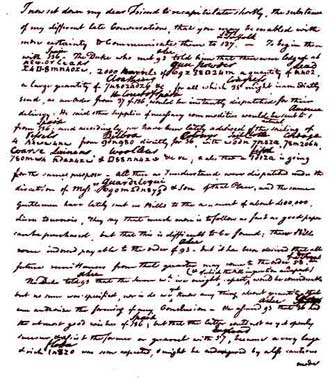
First page of deciphered intelligence sent by Edward Bancroft to London in May 1777. Courtesy of the British Library.
Editor: Erind Pajo
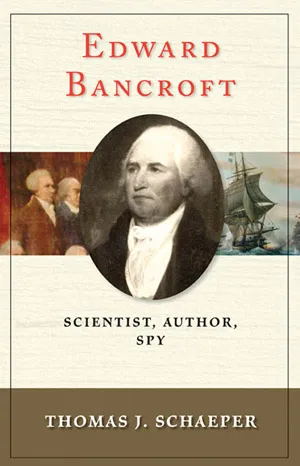
Edward Bancroft
Thomas Schaeper Edward Bancroft: Scientist, Author, Spy Yale University Press 352 pages, 6 1/8 x 9 1/4 inches ISBN 978 0300118421
Available here →June 8, 2011
20110608-schaeper-thomas-edward-bancroft-scientist-author-spy-2
The wide angle
The rest of this thread

Thomas J. Schaeper
Thomas J. Schaeper received his Ph.D. in history at Ohio State University. Since 1979 he has been a professor of history at St. Bonaventure University, in western New York State. His publications include France and America in the Revolutionary Era: The Life of Jacques-Donatien Leray de Chaumont, 1725-1803 (Berghahn Books, 1995), Rhodes Scholars, Oxford, and the Creation of an American Elite (Berghahn Books, 2010), and Edward Bancroft: Scientist, Author, Spy (Yale University Press, 2011).
Pull this thread
Bancroft was a Loyalist, not a traitor, and Franklin was not his accomplice.
Know something the rest of us don't?
Most threads on Rorotoko begin with our invitation. Any thread can begin with a proposal: you write it with the same prompts every thread answers, and we review it.
Propose a thread →