
Lydia H. Liu
The Freudian Robot
Are we turning into Freudian robots anytime soon? This is a question I was greatly tempted to put to a psychoanalyst. It turns out that French psychoanalyst Jacques Lacan showed a keen interest in the logic of the human psyche as proposed by cyberneticians and tried to reinterpret Freud in that light. In one of my chapters, I singled him out for analysis and hoped that his insight would help answer the above question (pp.153-199). It is interesting that Lacan did not come up with the notion of the Symbolic Order until after he had been exposed to the cybernetic hypothesis about the logic of the human psyche.
Strangely, Lacan’s engagement with game theory and cybernetics in the mid-1950s has remained hidden in plain sight. And this oversight is largely responsible for many of the misleading interpretations of his theory. It also prevents us from reflecting on the reception of American cybernetics in France. I spent a lot of time researching how Lacan was first introduced to cybernetics and game theory and published the results in an article called “The Cybernetic Unconscious” in Critical Inquiry in spring 2010. That article was subsequently elaborated and turned into a chapter of the book.
In that chapter, I point out that the transatlantic invention of French literary theory, and the translation of Lacan in particular during the 1950s and 60s has succeeded in obscuring the vital historical linkages between game theory, cybernetics, and information theory on the one hand and French literary and social theories on the other.
I see this as a kind of blindness in the play of mirrors between postwar France and America. As a matter of fact, Lacan’s own seminars of 1954-55 provide clear evidence that the French psychoanalyst looked upon cybernetics and information theory as an alternative intellectual framework—alternative to French Hegelianism—for rethinking Freud, especially his notion of the unconscious. Lacan tried very hard to get away from the philosophy of consciousness in all its incarnations from his time.
But why should we be concerned with the work of Lacan in a study of the Freudian robot? Well, we need to remember that the spectacular developments in cybernetics and cognitive sciences in the latter part of the 20th century were all driven by the assumption that the logic of the computing machine was isomorphic with the logic of the human psyche. This assumption comes originally from a hypothesis in the pioneering work of first-generation cybernetians Warren McCulloch and Walter Pitts. Lacan was not only attracted to this hypothesis but also attempted to develop the idea of the unconscious from this unique angle.
People say that Lacan’s Symbolic Order is all about language. Yes, and no, that is to say, if we take his idea of language not in a Saussurian sense—as is commonly asserted—but in a cybernetic sense or in the language of cybernetic machines as my book has tried to make clear—then I think we are getting a bit closer to what he means by language.
Lacan calls the computer “a calculating machine” and says that this machine can be “far more dangerous for man than the atom bomb.” This enigmatic remark compresses some of his most important insights on the unconscious and the Symbolic Order. I believe that Lacan contribution in this area—which I try to spell out for him since he did not do so himself—lies in what he can tell us about the cybernetic unconscious of the postwar Euro-American world order. That was his genius. The birth of the Freudian robot cannot be thought independently of the postwar Anglo-American world order.
Unfortunately, we have not been able to escape that world order after Lacan’s passing and after the Cold War. Today, theoretical discourses devolve into all kinds of loose descriptive pronouncements about globalization, if not glib postmodern rhetoric. But there are compelling reasons for us to once again engage with Lacan’s hard won insights and make them relevant to future thought.
The narrowness of academic literary training tends to blind us to some of the most important inventions not only in communication technologies but in the evolution of alphabetical writing. Literary scholars work with written texts—even those who study oral literature cannot do without textual inscriptions—yet many of us remain ignorant of what scientists have done to the idea of alphabetical writing.
To reeducate myself, I looked into the cross-disciplinary evolution of written symbols, especially English writing, and its relation to digital writing. I hope that teachers and students in the humanities and social sciences will read The Freudian Robot and experience a similar kind of reeducation as I did in the writing of this book.
New media studies attract a great deal of attention these days both in academia and among the general public. A common perception there is that psychoanalysis has little to do with digital media and that digital media have nothing to do with psychoanalysis.
I believe I offer in this book indisputable evidence that digital media and psychoanalysis have been mutually entangled from the very beginning.
The pivot of that entanglement is the changing identity and role of language and writing after alphabetical writing made an ideographic turn in the mid-twentieth century. This raises the fundamental question of how human-machine relationships can be rethought at the level of the unconscious. And this is where a comparative and cross-disciplinary approach proves necessary and particularly fruitful.
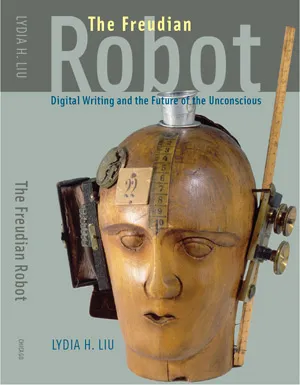
The reader may judge this book by its cover. I love the Dadaist image by Raoul Hausmann—one of my favorite Dadaists who lived in a time when avant-garde art and politics enjoyed a meaningful relationship. Hausmann’s original installation was called The Mechanical Head: The Spirit of Our Age. It mesmerized me when I first encountered it in a museum exhibition, and I could not think of a better metaphor for the image of the Freudian Robot.
Editor: Erind Pajo
The Freudian Robot
Lydia H. Liu The Freudian Robot: Digital Media and the Future of the Unconscious University of Chicago Press 320 pages, 6 x 9 inches ISBN 978 0226486826 ISBN 978 0226486833
Available here →June 13, 2011
20110613-liu-lydia-freudian-robot-digital-media-future-unconscious-3
A close-up
The rest of this thread

Jill LeVine
Lydia H. Liu
Lydia H. Liu is a theorist of media and translingual practices and a scholar of modern Chinese literature and culture. She is the W. T. Tam Professor in the Humanities in the Department of East Asian Languages and Cultures and at the Institute of Comparative Literature and Society at Columbia University. Besides The Freudian Robot, featured in her Rorotoko interview, she is the author of The Clash of Empires: The Invention of China in Modern World Making (2004), Translingual Practice: Literature, National Culture, and Translated Modernity (1995) and other works in English and Chinese.
Pull this thread
The computer runs on the manipulation of discrete written symbols, not on language, and Lacan's Symbolic Order is cybernetic.
Know something the rest of us don't?
Most threads on Rorotoko begin with our invitation. Any thread can begin with a proposal: you write it with the same prompts every thread answers, and we review it.
Propose a thread →