
Lydia H. Liu
The Freudian Robot
I wrote this book to ask some new questions about our relationship to modern technology. As the world is constantly being changed by new technological inventions, what is the psychic impact of these changes on people as individuals and collectives? I am referring to the kind of social transformations that used to take centuries to develop but now accelerate by leaps and bounds in a person’s lifetime.
Of course, I am not the first to raise these issues; critics have been concerned about human-machine relationship for decades. What interests me here is the emergence of Freudian robots in our time.
I devote a chapter to analyzing the psychic implications of artificial intelligence and robotics—such as the work of AI scientist Marvin Minsky. Robot designers have been promoting the science fiction of cyborgs, androids, and humanoids and want their robots to resemble human beings not only in basic cognitive and motor abilities but also in the unconscious, complete with neurosis, ego, superego and whatnot.
I am fascinated by this unreflective narcissism and am worried about its destructive potential in the future.
I think the reader will find the work of Japanese robot engineer Masahiro Mori intriguing. Mori is known for his theory of “the Uncanny Valley” in the AI industry and he happens to share my criticism of the narcissism of current robot models.
Mori read his Freud for critical insight. His idea of a Buddha robot appears to present an alternative to the Freudian robot, but no one has yet attempted to build a model of the Buddha robot. What would it look like? Will it be easier for machines to achieve Buddhahood than for humans? Essentially, we need to face some larger questions concerning the received notion of humanness and its limits. That notion, I argue, is being fundamentally challenged by the appearance of Freudian robots.
What is a Freudian robot? I define the Freudian robot as “any networked being who embodies the feedback loop of human-machine simulacra and cannot free her/him/itself from the cybernetic unconscious.”
Call it a cyborg, android, or posthuman, the lines between robots and humans are getting increasingly blurred. Just as robots are built to resemble humans more and more closely, humans think and behave more and more like robots. I believe this can tell us something about our co-evolution with the technologies we invent and, ultimately, what human civilization is all about.
Editor: Erind Pajo
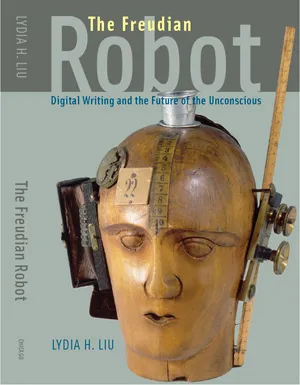
The Freudian Robot
Lydia H. Liu The Freudian Robot: Digital Media and the Future of the Unconscious University of Chicago Press 320 pages, 6 x 9 inches ISBN 978 0226486826 ISBN 978 0226486833
Available here →June 13, 2011
20110613-liu-lydia-freudian-robot-digital-media-future-unconscious-1-1
In a nutshell
The rest of this thread

Jill LeVine
Lydia H. Liu
Lydia H. Liu is a theorist of media and translingual practices and a scholar of modern Chinese literature and culture. She is the W. T. Tam Professor in the Humanities in the Department of East Asian Languages and Cultures and at the Institute of Comparative Literature and Society at Columbia University. Besides The Freudian Robot, featured in her Rorotoko interview, she is the author of The Clash of Empires: The Invention of China in Modern World Making (2004), Translingual Practice: Literature, National Culture, and Translated Modernity (1995) and other works in English and Chinese.
Pull this thread
pulls againstpulls alongside
The computer runs on the manipulation of discrete written symbols, not on language, and Lacan's Symbolic Order is cybernetic.
Nearby AM · The idea of robots is ancient, and Hesiod's Talos, with inner workings and a power source, qualifies as one.
Nearby JB · Accident proneness died because engineers moved safety from sorting people to redesigning environments.
Nearby LS · Soviet middle echelons finally demanded the car as their share of the empire's wealth, and they got it.
Know something the rest of us don't?
Most threads on Rorotoko begin with our invitation. Any thread can begin with a proposal: you write it with the same prompts every thread answers, and we review it.
Propose a thread →