
Charles T. Clotfelter
Big-Time Sports in American Universities
The United States is the only country with universities that participate in what amounts to commercial sports entertainment.
Why this happened in America and not elsewhere is interesting to contemplate. James Michener called it a “quirk of history.” But what is relevant for our time is the unshakable hold that big-time sports continues to have over the universities that engage in it.
For almost a century, big-time college sports has been a wildly popular but consistently problematic part of American higher education. The challenges it poses to traditional academic values have been recognized from the start, but they have grown more ominous in recent decades, as cable television has become ubiquitous, commercial opportunities have proliferated, and athletic budgets have ballooned.
The book asks two questions. Why do universities play big-time football and basketball? And: Is it good for them or not?
I set out to gather information that would shine light on the role of commercial sports and then let the facts speak for themselves. I reasoned that there was already plenty of opinion concerning big-time sports, its problems, and reform proposals. I consulted histories and analyses, used published information, and collected new, unpublished data. I tried to make it an empirical book about universities, not about sports.
The book looks at big-time college sports in four different ways: as a consumer product (and the subject of mass hysteria), as a business that many universities undertake, as a tool for building institutional support, and as an implicit component of education for the university’s students.
I conclude that the unshakable hold that big-time sports has over the universities where it exists cannot be explained by the benefits that athletic competition brings to the academic mission alone. Rather, the ingredient that gives big-time sports its remarkable staying power is quite simply support from the top: university trustees or regents want to have competitive teams.
As to the benefits and costs, the college sports enterprise is decidedly a mixed bag. The much-denounced costs are all too real, but there are also some unheralded benefits as well. In any case, it is an American phenomenon that is not going away.
Editor: Erind Pajo
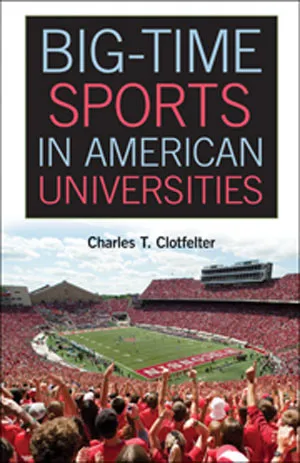
Big-Time Sports in American Universities
Charles T. Clotfelter Big-Time Sports in American Universities Cambridge University Press 320 pages, 6 x 9 inches ISBN 978 1107004344
Available here →June 27, 2011
20110627-clotfelter-charles-big-time-sports-american-universities-1-1
In a nutshell
The rest of this thread

© The Duke Chronicle
Charles T. Clotfelter
Charles Clotfelter is professor of public policy and professor of economics and law at Duke University and a research associate in the National Bureau of Economic Research. Among his previous books are After Brown: The Rise and Retreat of School Desegregation (2004), Buying the Best: Cost Escalation in Elite Higher Education (1996), and (with Philip Cook) Selling Hope: State Lotteries in America (1989). He is also editor of American Universities in a Global Market (2010). While at Duke, Clotfelter has served as Vice Provost for Academic Policy and Planning, Vice Chancellor, and Vice Provost for Academic Programs., Way is the author of numerous books, including Everyday Courage: The Lives and Stories of Urban Teenagers.
Pull this thread
Big-time sports is a core university function, sustained by trustees and regents who insist on competitive teams.
Know something the rest of us don't?
Most threads on Rorotoko begin with our invitation. Any thread can begin with a proposal: you write it with the same prompts every thread answers, and we review it.
Propose a thread →