
Charles T. Clotfelter
Big-Time Sports in American Universities
Because my approach was agnostically empirical, the book ended up packed with information not previously known or associated with universities.
Here are a few examples.
I addressed a question that has been written about but never really analyzed: how does a media event like the NCAA tournament affect patterns of work? I was able to obtain permission from 78 research libraries to access data from an on-line repository of academic journals on the number of articles viewed every day for 90 days straight in three successive years. That analysis showed that work drops in the days after “Selection Sunday,” when many people are filling out their brackets; that those whose teams are in the tournament do less work; and that those whose teams win unexpectedly experience a precipitous, but short-term, drop in the work they do.
Another finding relates to the much-ballyhooed rise in coaches’ salaries. I found that these salaries are worth the attention because they have been growing at a phenomenal rate. Between 1986 and 2010, a period when the average pay for full professors at 44 public universities increased by 32% after inflation, and that of the presidents increased by 90%, pay for the head football coaches at those same institutions increased six and a half times, or about 650%.There are many other indications that the world of big-time sports is wholly separate from the academic sides of many of our great universities.
At the University of Texas, for example, the football team rides to practice every day during the season aboard chartered buses and dresses out in a locker room equipped with five flat-screen TVs and adorned with a 20-foot ceiling light in the shape of a longhorn.
Though it might be a business enterprise for the universities, big-time sports is a source of sincere devotion for many ordinary Americans.
In Alabama, the state’s two biggest sports universities are the object of attention from the governor on down. By tradition, the home team in the annual Auburn-Alabama football game offers two free tickets to every member of the Alabama legislature; the state’s governor traditionally received two dozen tickets to every Auburn and Alabama home game. In 2010 Auburn drew an impressive crowd of 63,000 for to its annual scrimmage game, and Alabama had an astonishing 91,000. And numerous obituaries appearing in newspapers like the Birmingham News contain references to people’s lifelong devotion to a team. One among the many that appeared in 2010 stated, “He was a man of faith who loved his family, his church, his community and the Alabama Crimson Tide.”
As unlikely as it might sound at first, big-time sports provides an illuminating vantage point from which to assess the purpose of many American universities.
At the outset, I rather expected to find in the big-time college athletic department an organization that is highly commercial and wholly unrelated to the main purposes of the university. Commercial it is, but unrelated it is not. Our universities are not solely academic institutions. In a real sense, they are in the entertainment business. For these universities, being competitive in intercollegiate sports has the look and feel of a core mission. For the flagship and land-grant public universities in particular, big-time college sports long ago became part of the cultural extension of the university throughout their states. It has become the populist face of these universities. Reflecting the importance that citizens and alumni place on athletic success, trustees and boards of governors insist that their universities do what is necessary to have competitive teams.
Big-time sports holds the potential for real benefit to the academic enterprise. Although most athletic departments fail to earn enough to cover the cost of all their university's teams, the evidence suggests that successful big-time programs help to attract applicants, stimulate charitable contributions, and bolster support from the community and state.
Beyond the campus walls, the same devotion that makes college sports commercially valuable also represents an authentic but unheralded social benefit: the sheer enjoyment and pride that citizen-fans feel. Economists call it “consumer surplus,” but the everyday term is “happiness.”
Another social benefit of big-time college sports is its potential to teach by example civic values like meritocracy and productive interracial cooperation. One of the forces that opposed many Southerners’ fierce embrace of segregation was another cherished tradition: college football. Coaches who treated their players equally and interracial teams that worked together provided much-needed models for the region and the country. This teaching by example continues today, as racially diverse college teams play together with a harmony shown in high fives and fist bumps.
None of this is to deny that big-time sports creates troubling conflicts in values and tempts universities to be less than candid about the compromises made in the pursuit of competitive teams. But faculty members and administrators do a disservice to themselves and their institutions by pretending that the sports-entertainment complex is no more significant to a university's functioning than are its dining halls or drama clubs.
It would be healthier for American higher education to come to terms with its deep commitment to entertainment in the form of big-time sports. The ongoing debate over “what is to be done about college sports?” could then be more realistic and possibly more effective.
Editor: Erind Pajo
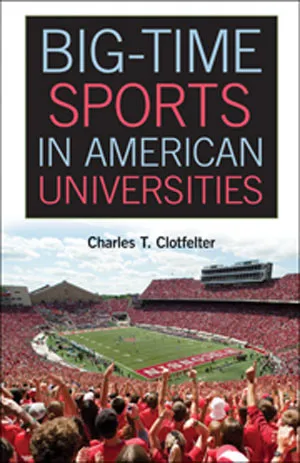
Big-Time Sports in American Universities
Charles T. Clotfelter Big-Time Sports in American Universities Cambridge University Press 320 pages, 6 x 9 inches ISBN 978 1107004344
Available here →June 27, 2011
20110627-clotfelter-charles-big-time-sports-american-universities-3
A close-up
The rest of this thread

© The Duke Chronicle
Charles T. Clotfelter
Charles Clotfelter is professor of public policy and professor of economics and law at Duke University and a research associate in the National Bureau of Economic Research. Among his previous books are After Brown: The Rise and Retreat of School Desegregation (2004), Buying the Best: Cost Escalation in Elite Higher Education (1996), and (with Philip Cook) Selling Hope: State Lotteries in America (1989). He is also editor of American Universities in a Global Market (2010). While at Duke, Clotfelter has served as Vice Provost for Academic Policy and Planning, Vice Chancellor, and Vice Provost for Academic Programs., Way is the author of numerous books, including Everyday Courage: The Lives and Stories of Urban Teenagers.
Pull this thread
Big-time sports is a core university function, sustained by trustees and regents who insist on competitive teams.
Know something the rest of us don't?
Most threads on Rorotoko begin with our invitation. Any thread can begin with a proposal: you write it with the same prompts every thread answers, and we review it.
Propose a thread →