
Ann Blair
Too Much to Know
This book is about how the feeling of being overloaded with information, especially things to read, isn't a recent phenomenon. Similarly the tools for coping with overload, notably by managing information, have a long history.
In antiquity and the middle ages already scholars complained about the overabundance of books and the management tools in use included compilations of summaries and excerpts, organized under subject headings, and (starting in the 13th century) alphabetical indexing. When the spread of printing in the mid-15th century massively increased the number and availability of books, a much broader swath of the educated experienced overload and looked for remedies. The conditions were right for the commercial success of the reference book, which offered ready for use the best bits from all those books one didn’t have time to read.
Early printed reference books reached amazing proportions: a "standard" reference book like Domenico Nani Mirabelli's Polyanthea, printed in over 40 editions, reached 2.5 million words by the early 17th century. The largest reference book exceeded 10 million words, in eight massive folio volumes.
For comparison the last print version of the Encyclopedia Britannica, in 1985, amounted to 40 million words. Wikipedia, freed from the constraints of production on paper, has far surpassed these numbers; the English-language Wikipedia is now close to an estimated 2.5 billion words (according to the page linked here, as accessed on June 16, 2011).
I investigate how such huge books were made in the days of manuscript composition and the hand press. Compilers used their own copious notes taken by copying excerpts from their reading. But they also included material collected by others, in print or in manuscript. Then, to save labor, material for a large book was often cut and pasted (very literally, with scissors and glue) from notes, letters or even printed books. Once a first edition was published, it served as the basis for regularly expanded reeditions, to which compilers and their printers added new material and new finding devices of increasing sophistication, such as lists of contents with PowerPoint-style indentations and multiple kinds of alphabetical indexes.
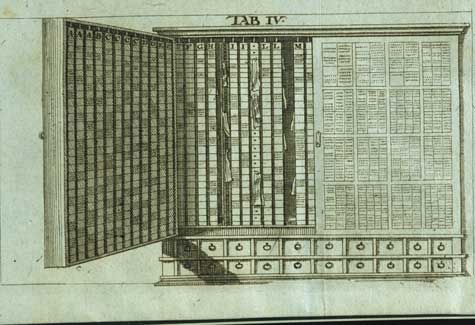
Vincent Placcius, De arte excerpendi (1689), following page 153 in the book. Placcius notes that he was drawing on an earlier English manuscript from the 1640s, a copy of which is preserved at the British Library, and which has recently been identified as the work of Thomas Harrison, active in the circle of Samuel Hartlib.
Editor: Erind Pajo
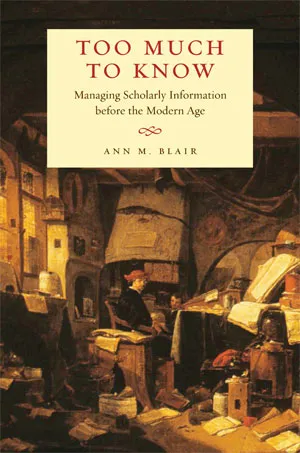
Too Much to Know
Ann Blair Too Much to Know: Managing Scholarly Information before the Modern Age Yale University Press 416 pages, 6 x 10 inches ISBN 978 0300112511 ISBN 978 0300165395
Available here →July 6, 2011
20110706-blair-ann-too-much-to-know-managing-information-before-modern-age-1-1
In a nutshell
The rest of this thread

Justin Ide /Harvard University
Ann Blair
Ann Blair is Henry Charles Lea Professor of History at Harvard University. She teaches courses in early modern European intellectual and cultural history and book history. She is the author of The Theater of Nature: Jean Bodin and Renaissance Science (Princeton, 1997), and Too Much To Know, featured in her Rorotoko interview.
Pull this thread
Information overload is not a modern condition.
Know something the rest of us don't?
Most threads on Rorotoko begin with our invitation. Any thread can begin with a proposal: you write it with the same prompts every thread answers, and we review it.
Propose a thread →