
Ann Blair
Too Much to Know
My favorite chapter is the one on note-taking (chapter two). It is about how students and adults in the Renaissance were taught and encouraged to take notes.
Humanist pedagogues argued that note-taking served as a crucial aid to memory in two ways. First, it involved slowing down one's reading to write out the best parts and thus helped the reader attend to and retain the material better. Second, note-taking created a stock of written material which could be accumulated, sorted and indexed, and used throughout a lifetime as a storehouse from which to draw examples and quotations in speaking and composing new texts.
For the most committed note-takers one German professor, Vincent Placcius, published in 1689 instructions for building a large closet in which to store one's notes taken on slips of paper: when opened out the closet could store up 3,000 topical labels, each with a hook onto which to stick the slips that corresponded to that topic.
Placcius boasted that the closet could be especially useful for collaborative projects. For example students working together or the members of a learned society could pool their notes in one closet and then draw there from the collective stock of notes. At least two of these closets were built in the late 17th century, though we know of none that survive today.
Examining the working methods of scholars in the 16th and 17th centuries, as they faced an overabundance of books on a hitherto unprecedented scale, can help us see ourselves in a long history of managing information.
We still rely on techniques devised in the middle ages and the early modern period even as we develop new digital tools as well.
Some techniques with a long history (like alphabetization) may become obsolete as others take their place. And yet, through all the changes underway and still to come, I hope that we will continue to cultivate the qualities of mind that have always been at the root of intellectual reflection: human attention and memory and well-honed judgment.
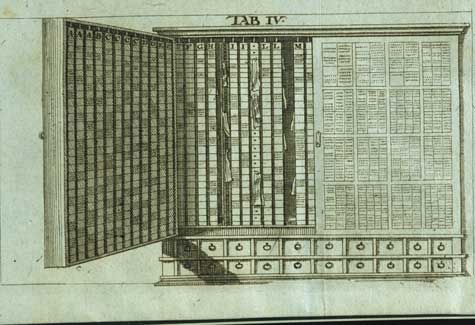
Vincent Placcius, De arte excerpendi (1689), following page 153 in the book. Placcius notes that he was drawing on an earlier English manuscript from the 1640s, a copy of which is preserved at the British Library, and which has recently been identified as the work of Thomas Harrison, active in the circle of Samuel Hartlib.
Editor: Erind Pajo
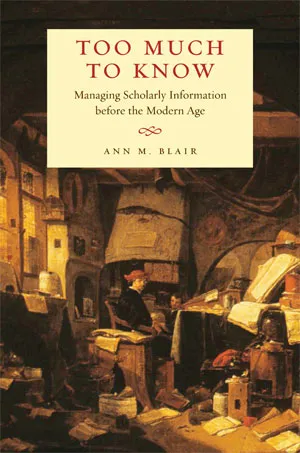
Too Much to Know
Ann Blair Too Much to Know: Managing Scholarly Information before the Modern Age Yale University Press 416 pages, 6 x 10 inches ISBN 978 0300112511 ISBN 978 0300165395
Available here →July 6, 2011
20110706-blair-ann-too-much-to-know-managing-information-before-modern-age-3
A close-up
The rest of this thread

Justin Ide /Harvard University
Ann Blair
Ann Blair is Henry Charles Lea Professor of History at Harvard University. She teaches courses in early modern European intellectual and cultural history and book history. She is the author of The Theater of Nature: Jean Bodin and Renaissance Science (Princeton, 1997), and Too Much To Know, featured in her Rorotoko interview.
Pull this thread
Information overload is ancient, and selecting, summarizing, sorting and storing are still how we cope.
Know something the rest of us don't?
Most threads on Rorotoko begin with our invitation. Any thread can begin with a proposal: you write it with the same prompts every thread answers, and we review it.
Propose a thread →