
Darrell Duffie
How Big Banks Fail and What to Do about It
The book’s story line carries, I hope, some dramatic interest. And it demands relatively little background knowledge. A reader whose curiosity is piqued will hopefully go further and cover the supporting concepts and institutional knowledge in the remaining chapters.
Start with the opening of Chapter 1. A few pages here take the reader through the death throes of a large bank that is an active intermediary in markets for securities, derivatives, and overnight borrowing. The bank is losing its battle to maintain liquidity.
The bank’s shareholders and managers cannot be easily convinced to raise new capital. Its counterparties, clients, and creditors are deserting it, one after another. They are in an effective run, racing each other to extract the cash that remains at the failing bank. The bank supplies cash to them readily, at first, in an attempt to signal its strength. To do otherwise would only heighten fears and accelerate the run. In the end, however, our protagonist bank cannot turn its illiquid assets into cash quickly enough to survive.
This bank is a fictional but realistic composite of Bear Stearns, Lehman Brothers, and Morgan Stanley. Morgan Stanley did not ultimately fail. It had a viable business and substantial assets—but its dramatic loss of liquidity threatened its collapse in the days following the October-2008 failure of Leman Brothers. I believe that Morgan Stanley would have indeed failed but for the dramatic provision of liquidity to it by the Federal Reserve Bank of New York.
There are undoubtedly sources of future financial crises that experts do not even contemplate today.
But the failure mechanics I explain in this book do not depend on the cause of a financial crisis. These mechanics are relevant as soon as suspicions arise over the ability of a systemically important bank to sustain itself.
My hope is that readers will take away a deeper understanding of the incentives at play in and around these firms, the core “plumbing” of the financial system, and some of the key points of fragility in its design.
It is possible that some of those responsible for making important related regulatory or risk-management decisions could draw some helpful insights from this book. This was obviously one of my motives. Another goal was to transfer this knowledge to graduate students—at Stanford and other universities. Some of them will have pertinent leadership responsibilities in the future.
I also hope that some intellectually curious readers whose careers are not connected with financial markets, but are merely anxious to learn more about our financial system, will enjoy reading How Big Banks Fail.
Editor: Erind Pajo
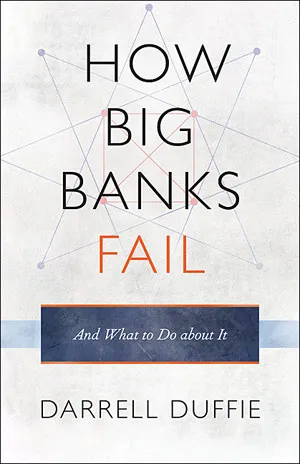
How Big Banks Fail and What to Do about It
Darrell Duffie How Big Banks Fail and What to Do about It Princeton University Press 112 pages, 5 1/2 x 8 3/4 inches ISBN- 978 0691148854
Available here →July 27, 2011
20110727-darrell-duffie-how-big-banks-fail-what-to-do-about-it-3
A close-up
The rest of this thread

Darrell Duffie
Darrell Duffie is the Dean Witter Distinguished Professor of Finance at Stanford University’s Graduate School of Business. He is a Fellow of the American Academy of Arts and Sciences and past President of the American Finance Association, and serves on the board of directors of Moody’s Corporation and on the Financial Advisory Roundtable of the Federal Reserve Bank of New York.
Pull this thread
A large dealer bank fails through a run by its short-term lenders, whatever caused the crisis.
Know something the rest of us don't?
Most threads on Rorotoko begin with our invitation. Any thread can begin with a proposal: you write it with the same prompts every thread answers, and we review it.
Propose a thread →