
Youssef Cassis
Crises and Opportunities
How far have bankers been held responsible for the outbreak of financial crises? Charles Baring, the first Lord Revelstoke, the firm’s senior partner, took the brunt of the Baring Crisis in 1890. He was blamed by his brother for his “insatiate vanity and extravagance.” He was liable for his entire fortune and he lost it. His house in Mayfair and his country estate in Devon had to be sold. Charles Barney, the President of the Knickerbocker Trust in New York, which suspended payment in October 1907 and triggered a financial panic, committed suicide a month later.
Wall Street’s leading bankers and financiers were pilloried during the Peccora investigation in 1933. To give but a single example: the total pay package of Charles Mitchell, the Citibank’s president, was revealed to exceed $1 million in 1929, when his basic salary was $25,000. Interestingly, questions were raised about “the propriety of permitting executives to share to such an extent the net earnings of financial institutions without having to bear any part of the losses,” and about the risk of a “lack of care in the handling and sale of securities to the public.”
Wall Street as a whole paid a heavy price for the crash, the banking crises and the depression—in terms of loss of prestige and loss of political influence. Banks and bankers were tamed for a generation. The contrast with 2008 is striking.
Responsibility cannot be entirely separated from ownership and control. Banks were the first companies, alongside railways, where ownership was separated from control—in the early to mid-nineteenth century. And yet big business in the financial world has never entirely freed itself from the dominance of private interests.
Private bankers remained highly influential in the world's two leading financial centers—the City of London, with the merchant banks, and Wall Street, with the investment banks. The financial elite then made money with its own capital.
Merchant banks and investments banks remained partnerships until the 1960s. However, their conversion into public companies did not entirely eradicate some aspects of the partnership form of organization, especially earnings and professional status, which have persisted in the governance of the world’s leading banks, including the large universal banks into which some of them have been integrated.
On a far greater scale than ever before, top salaried executives and star traders have been able to enjoy a level of remuneration previously only attained by private bankers risking their own capital. That this state of affaires contributed to the financial debacle of 2007-2008 cannot seriously be doubted.
Reflecting on more than a hundred year of financial crises, it appears that few opportunities for re-shaping the financial system have actually been seized. This is because significant changes are only carried out in the wake of very serious crises, and such crises have been a fairly rare occurrence.
The most significant changes took place in the United States: the panic of 1907 was followed by the creation of the Federal Reserve in 1913. And the banking crises of the early 1930s led, amongst others, to the Glass-Steagall Act of 1933 separating commercial banking from investment banking.
Wars have played a greater impact on European finance, with World War II, in particular, leading to far higher a degree of state intervention in financial affairs.
It also appears that changes in the financial architecture have always been a compromise between economic necessity and political expediency.
The Federal Reserve System was duly put in place in 1913, yet political compromises impaired its efficiency and a wider-ranging reform allowing branch banking and interstate banking was not contemplated.
Equally, it is doubtful that the Glass-Steagall Act addressed the main causes of the banking crises that broke out between 1930 and 1933: most of the small banks that failed during these years were only commercial banks, while the large New York banks, which had securities affiliates, survived the crisis. On the other hand, the introduction of deposit insurance, in other words the government commitment to make banks safer for depositors, could justify a measure limiting risk taking.
This leads one to wonder if the financial crisis of 2007-2008 has been severe enough to be followed by a fundamental reform of the financial system—as well as the extent to which the implemented reforms will have been impaired by political motives, including banks’ lobbying.
Editor: Erind Pajo
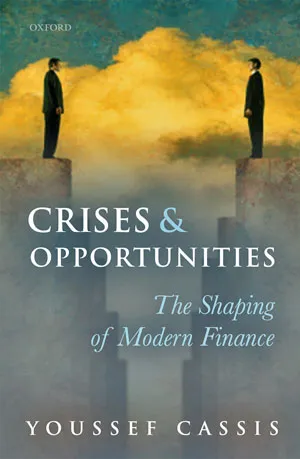
Crises and Opportunities
Youssef Cassis Crises and Opportunities: The Shaping of Modern Finance Oxford University Press 288 pages ISBN: 978 0199600861
Available here →August 8, 2011
20110808-cassis-youssef-on-crises-opportunities-shaping-modern-finance-3
A close-up
The rest of this thread

Youssef Cassis
Youssef Cassis is Professor of Economic History at the European University Institute, Florence. Besides Crises and Opportunities, featured in his Rorotoko interview, his books include City Bankers, 1890-1914 (Cambridge, 1994), Big Business: The European Experience in the Twentieth Century (Oxford, 1997), and Capitals of Capital: A History of International Financial Centres, 1780-2005 (Cambridge, 2006). Youssef Cassis cofounded the Financial History Review, is a member of the Academic Advisory Council of the European Association for Banking and Financial History, and past President of the European Business History Association.
Pull this thread
Financial crises have rarely been the forces for reshaping finance we want them to be.
Know something the rest of us don't?
Most threads on Rorotoko begin with our invitation. Any thread can begin with a proposal: you write it with the same prompts every thread answers, and we review it.
Propose a thread →