
Youssef Cassis
Crises and Opportunities
As the world’s political and economic leaders struggle with the aftermath of the financial debacle of 2008, this book asks: Have financial crises presented opportunities to rebuild the financial systems?
Given the violence of the shock, some fundamental questions have been raised about the working of the financial sector. Have banks become “too big to fail”? Should commercial banking be separated from investment banking? Have bonuses been responsible for the excesses leading to the crash? Should financial institutions be more tightly regulated? Will the financial sector shrink significantly in the foreseeable future? Will Wall Street and the City of London retain their world leadership or will they be upstaged by financial centers in Asia or the Middle East?
This book is an attempt to revisit the history of financial crises in the light of these very contemporary questions. Put another way: Financial crises have periodically undermined the financial world; have they also contributed to its reshaping?
Looking back at the global financial crises that have broken out since the late nineteenth century can help us understand what is happening today—the speed at which reforms are proceeding, the extent and limits of what is being achieved.
Crises and Opportunities examines five main issues. First, the banks themselves: Have big banks actually ever been allowed to fail? Second is governance, in particular bankers’ responsibility in times of crises. Third is regulation, its links with innovation, and the demand for deregulation and re-regulation. Fourth is international cooperation: the instinct of preservation which brings governments together when panic strikes, but the harder collective effort at improving the existing international financial architecture. Fifth is balance of power in international finance, reflected in no small way by the hierarchy of international financial centers.
History shows that many factors have contributed to the shaping of modern finance. Financial crises have been only one of them—and not necessarily the forces for change that we would like them to be in the wake of the debacle of 2008.
Editor: Erind Pajo
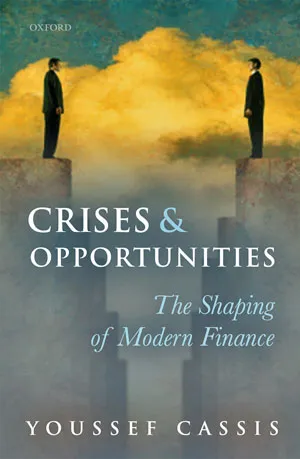
Crises and Opportunities
Youssef Cassis Crises and Opportunities: The Shaping of Modern Finance Oxford University Press 288 pages ISBN: 978 0199600861
Available here →August 8, 2011
20110808-cassis-youssef-on-crises-opportunities-shaping-modern-finance-1-1
In a nutshell
The rest of this thread

Youssef Cassis
Youssef Cassis is Professor of Economic History at the European University Institute, Florence. Besides Crises and Opportunities, featured in his Rorotoko interview, his books include City Bankers, 1890-1914 (Cambridge, 1994), Big Business: The European Experience in the Twentieth Century (Oxford, 1997), and Capitals of Capital: A History of International Financial Centres, 1780-2005 (Cambridge, 2006). Youssef Cassis cofounded the Financial History Review, is a member of the Academic Advisory Council of the European Association for Banking and Financial History, and past President of the European Business History Association.
Pull this thread
Financial crises have rarely been the forces for reshaping finance we want them to be.
Know something the rest of us don't?
Most threads on Rorotoko begin with our invitation. Any thread can begin with a proposal: you write it with the same prompts every thread answers, and we review it.
Propose a thread →